



Reported Speech
Reported speech tells someone what was said without repeating the exact words. With a past reporting verb, tenses often move back. The type of message determines whether you use a that-clause, an indirect question or a to-infinitive.
By the end of this lesson, you can
- Report statements, yes/no questions, wh-questions and commands.
- Adjust tense, pronouns and time or place references when the context changes.
Un bon cours, ça se partage.
Report statements and choose the right tense
| Direct speech | Reported later in a different context | Change |
|---|---|---|
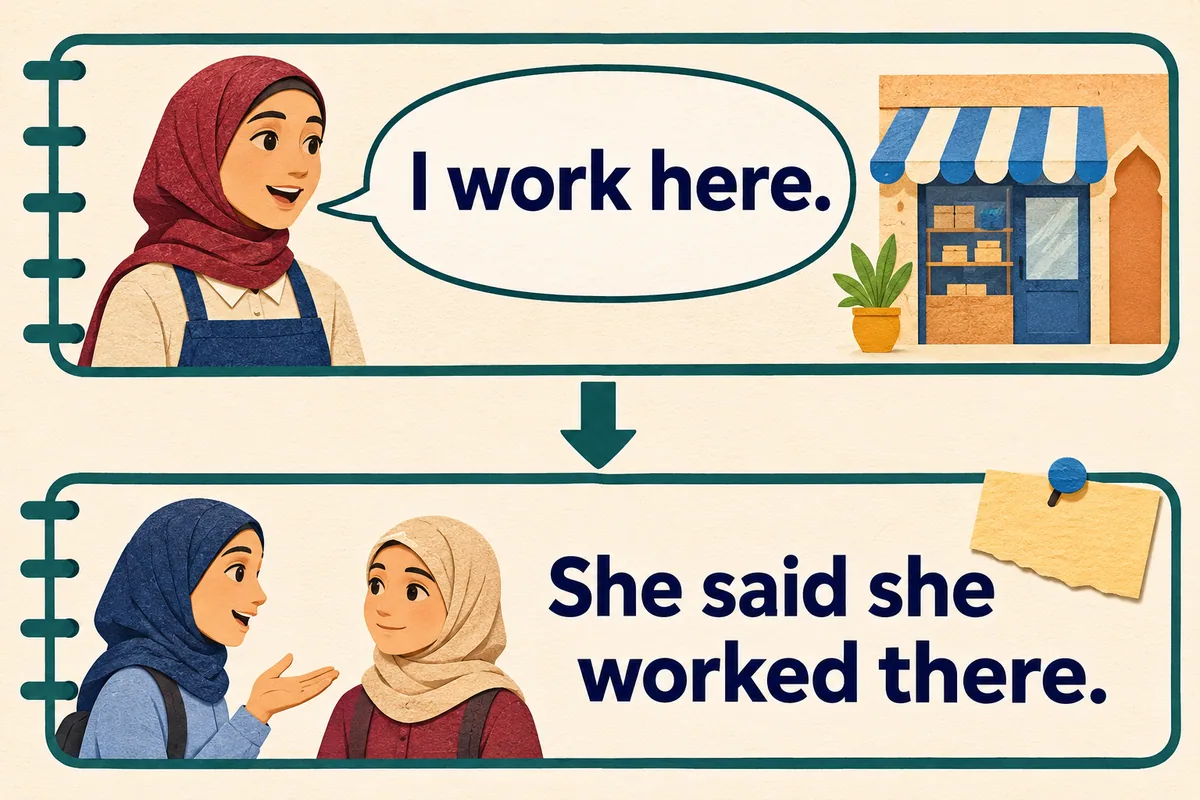
| « I work here. » | Amal said that she worked there. | present simple → past simple |
| « I am working today. » | She said she was working that day. | present continuous → past continuous |
| « We have finished. » | They said they had finished. | present perfect → past perfect |
| « I sent it yesterday. » | He said he had sent it the day before. | past simple → past perfect |
| « I will come tomorrow. » | She said she would come the next day. | will → would |
| « I can help now. » | He said he could help then. | can → could |
The past perfect stays the same, and could, should and might usually stay the same. With a present reporting verb, keep the original tense when the information still applies, as in « She says she works at the library. » After a past reporting verb, the present is also possible for a fact the speaker presents as still true. Adjust here, now, today and demonstratives such as this only when the reference changes.
Report questions, requests and commands
| Message | Direct speech | Reported version |
|---|---|---|
| yes/no question | « Did you vote? » | He asked me if I had voted. |
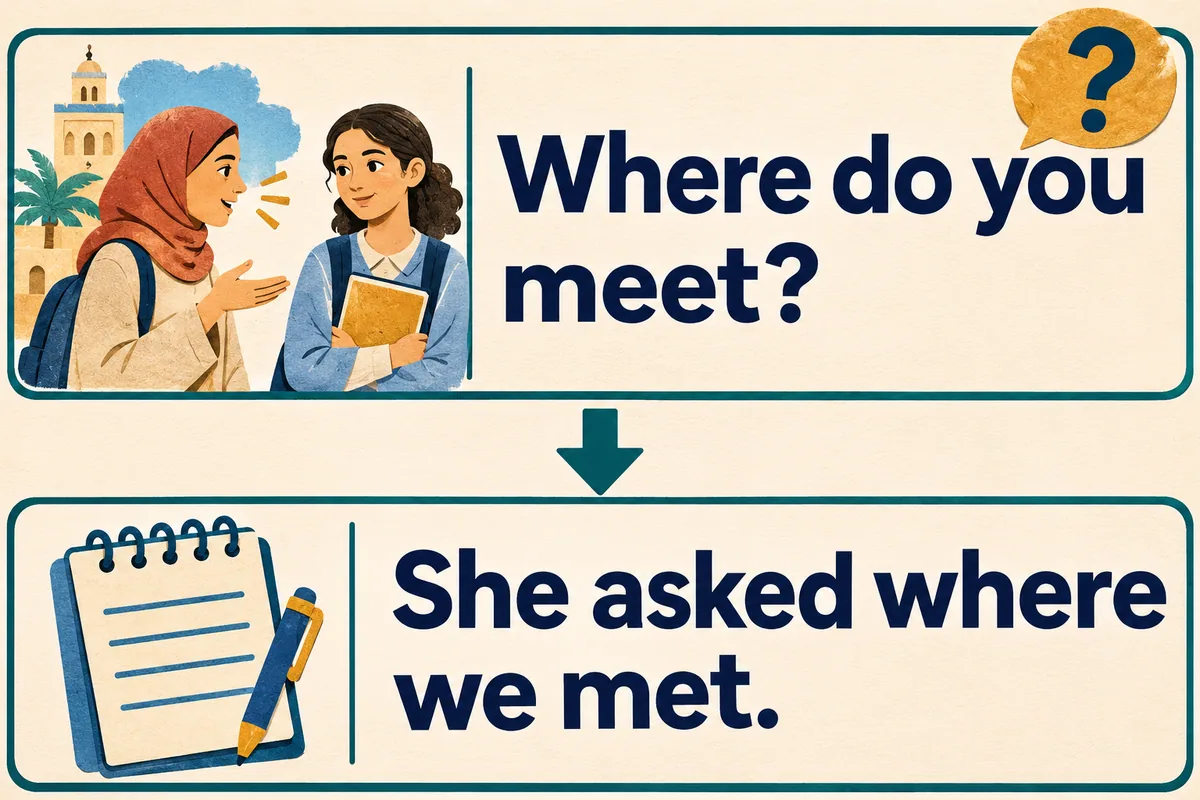
| wh-question | « Where do you meet? » | She asked where we met. |
| request | « Please bring your card. » | She asked me to bring my card. |
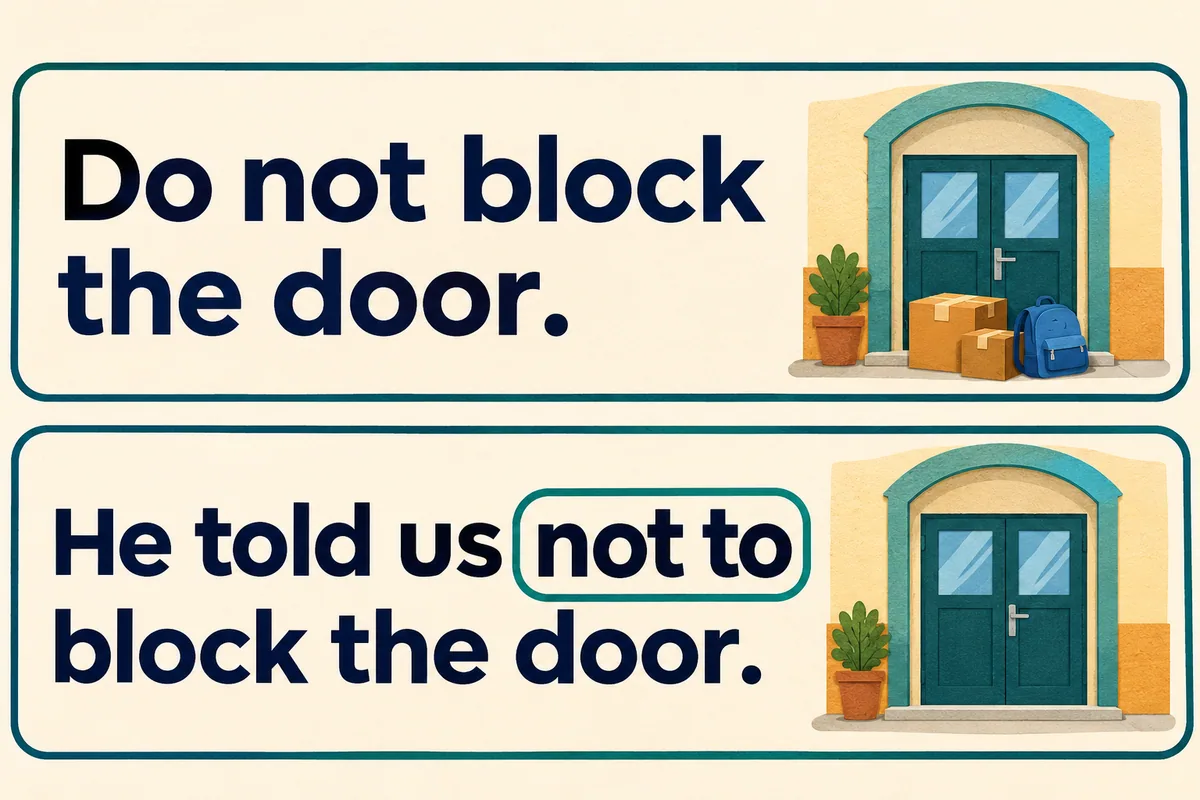
| negative command | « Don’t block the door. » | The caretaker told us not to block the door. |
Say, tell and ask
Say can introduce a statement directly. When a listener is included with say, use say to someone. Tell takes a person before the message, as in « She told me that the event was free ». For a reported question, use statement word order and drop do, does or did when they only form the question.
Remember
Choose changes from the context. If tomorrow still refers to the same day at the moment of reporting, you can keep it.
Worked examples: reporting step by step
Reporting a statement
Report « I am preparing the survey now, » Amal said.
- Change the pronoun to match the speaker: I becomes she.
- Move the tense back after the past verb said: am preparing becomes was preparing.
- Change the time word if the moment has passed: now becomes then.
- Final sentence: « Amal said (that) she was preparing the survey then. »
Say or tell?
Correct « She said me that the meeting was cancelled. »
- Tell is followed directly by the listener: « She told me that … ».
- Say is not followed directly by a person. If you mention the listener, use to: « She said to me that … ».
- Correct versions: « She told me that the meeting was cancelled » or « She said that the meeting was cancelled. »
Sources and curriculum
- English Language Guidelines for Secondary Schools (Ministry of Education, 2007)
The 2nd Baccalaureate syllabus describes the ten themes, four skills and language structures. See printed pages 76–84.
- National Baccalaureate Exam Specifications (English, 2025)
Reproduction of the national framework for the reading, language and writing sections, including the science streams.
Frequently asked questions
How do you change a question into reported speech?
Do we always change the tense in reported speech?
Exercises with answers
4 exercises, from easy practice to challenges. Try each one yourself, then reveal the answer and explanation.
Exercise 1
EasyComplete each sentence with said, told or asked.
- She ___ me that the meeting was cancelled.
- He ___ that he was tired.
- The teacher ___ us to sit down.
- They ___ if the bus was free.
- She ___ to me that she was sorry.
Answer and explanation
- Told. Tell takes the listener directly.
- Said.
- Told. Tell + person + to + base verb reports a command.
- Asked. It reports a yes/no question.
- Said. Say to + person.
Exercise 2
Intermediate- Report later: Amal said, « I’ll bring the survey tomorrow. »
- Report the question: « Why did you leave? » the chair asked me.
- Report the request: « Please don’t share their names, » the tutor told us.
Answer and explanation
- Amal said she would bring the survey the next day.
- The chair asked me why I had left. Use statement order.
- The tutor told us not to share their names.
Exercise 3
IntermediateReport each sentence. The reporting verb is in the past.
- « I live in Tangier, » said Omar.
- « We are going to vote tomorrow, » they said.
- « I have never visited the parliament, » said Sara.
- « I can’t come to the meeting, » he said.
- « The results will be published next week, » the mayor announced.
Answer and explanation
- Omar said (that) he lived in Tangier.
- They said (that) they were going to vote the next day.
- Sara said (that) she had never visited the parliament.
- He said (that) he couldn’t come to the meeting.
- The mayor announced that the results would be published the following week.
Exercise 4
ChallengeA journalist interviews Rim, a volunteer. Report each line in a full sentence.
- Journalist: « How long have you been volunteering? »
- Rim: « I started two years ago. »
- Journalist: « Do you enjoy it? »
- Rim: « Yes, I do. Come and join us next Saturday! »
Answer and explanation
- The journalist asked Rim how long she had been volunteering.
- Rim said (that) she had started two years before.
- The journalist asked her if (or whether) she enjoyed it.
- Rim said she did and invited the journalist to come and join them the following Saturday.