



Brain Drain Vocabulary
Brain drain is the loss of skilled workers or graduates when they move away and their place of origin loses access to their skills. Unit 10 of English 2 Bac also covers return migration, diaspora links and ways skills can circulate.
By the end of this lesson, you can
- Define brain drain, brain gain and brain circulation.
- Use vocabulary to explain causes and effects of skilled migration.
Un bon cours, ça se partage.
Key terms for skilled migration
| Term | Meaning | Example |
|---|---|---|
| emigrate | leave a country to settle elsewhere | The researcher emigrated from her country of origin. |
| immigrate | enter another country to settle there | She immigrated to the country where she found a post. |
| push factor | a condition that encourages people to leave | Limited access to specialist training can be a push factor. |
| pull factor | a condition that attracts people to a destination | A well-equipped laboratory can be a pull factor. |
| brain gain | an increase in skills available in a place | A training programme for returning engineers may contribute to brain gain. |
| brain circulation | movement and exchange of skills across borders | The researcher shares methods with both laboratories. |
| diaspora | people with origins in a place who live outside it, and their communities | A diaspora network offers mentoring to students. |
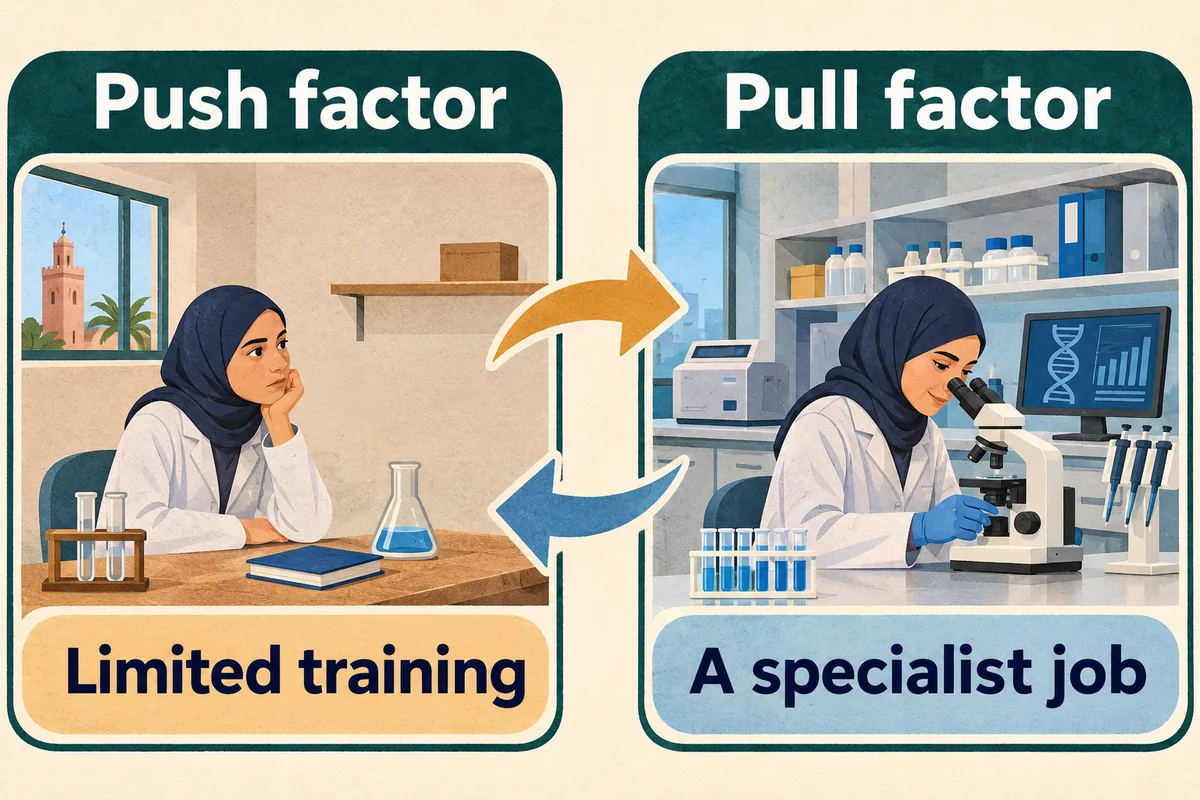
Collocations for causes, effects and solutions
Use seek better prospects, face a skills shortage, attract qualified workers, retain skilled staff and transfer knowledge. A shortage may grow when departures leave posts vacant. A return programme may help if it offers meaningful work and access to equipment.

Describe an effect in a specific context
A newly trained engineer may gain experience abroad and later share it through mentoring or return. A local company may still struggle if it cannot fill the engineer’s former post. Name the people, place and timeframe when explaining who gains or loses.
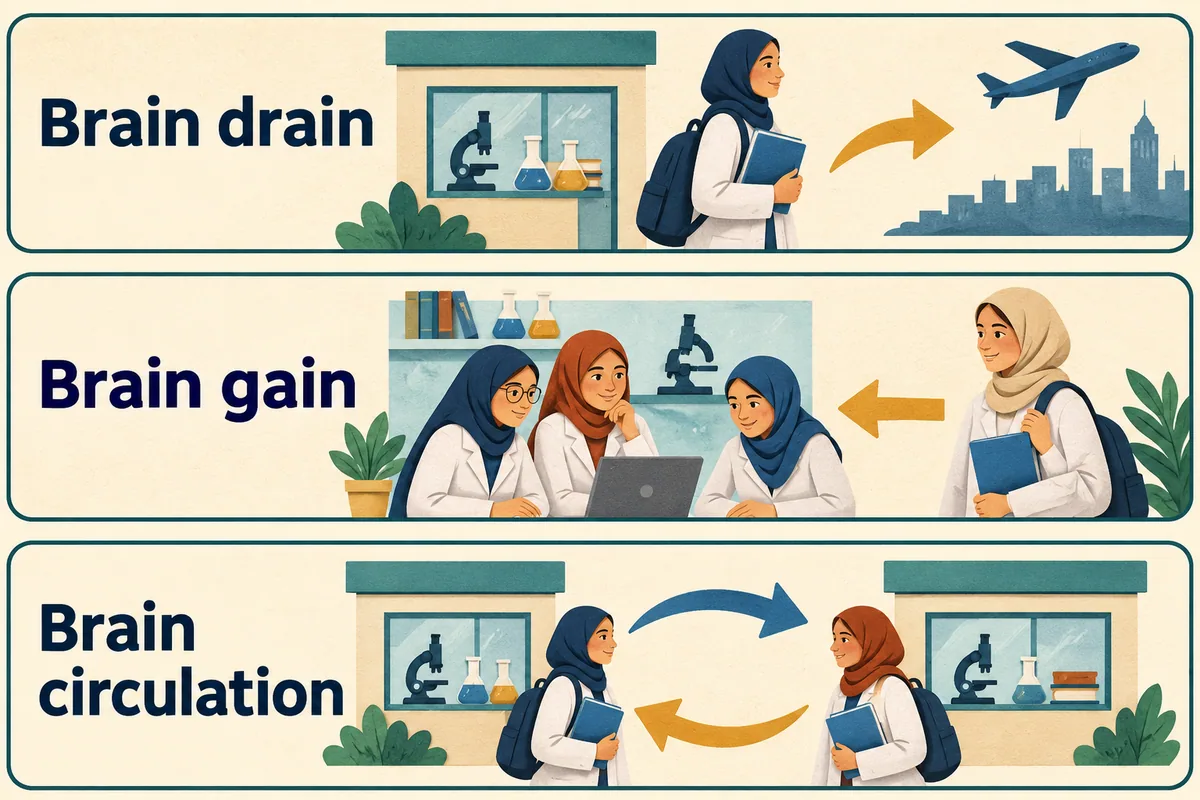
Worked examples: explaining skilled migration
Emigrate or immigrate?
Complete « Many young doctors ___ from their country and ___ to Canada. »
- Emigrate looks at the move from the country of origin, so it goes with from: emigrate from.
- Immigrate looks at the move from the country of destination, so it goes with to: immigrate to.
- The nouns follow the same logic: an emigrant leaves, an immigrant arrives, and migrant is the neutral word for both.
Drain, gain or circulation?
Classify three situations: an engineer leaves and never comes back; a researcher returns home with new skills; a professor abroad teaches online courses at her former university.
- The engineer’s skills are lost to the country of origin: brain drain.
- The researcher brings new skills back: brain gain.
- The professor shares knowledge across borders while living abroad: brain circulation.
Sources and curriculum
- English Language Guidelines for Secondary Schools (Ministry of Education, 2007)
The 2nd Baccalaureate syllabus describes the ten themes, four skills and language structures. See printed pages 76–84.
- National Baccalaureate Exam Specifications (English, 2025)
Reproduction of the national framework for the reading, language and writing sections, including the science streams.
Frequently asked questions
What are push and pull factors in brain drain?
What is the difference between brain drain and brain gain?
Exercises with answers
4 exercises, from easy practice to challenges. Try each one yourself, then reveal the answer and explanation.
Exercise 1
EasyChoose the term from the box for each definition: emigrant, immigrant, diaspora, skilled worker, remittances.
- A person who leaves their country to live in another one.
- A person who arrives in a country to live there permanently.
- Money that migrants send to their families in their country of origin.
- A person with special training or qualifications for a job.
- People from one country who live in other countries, and their communities.
Answer and explanation
- An emigrant.
- An immigrant.
- Remittances.
- A skilled worker.
- The diaspora.
Exercise 2
Intermediate- A nurse leaves because specialist posts are rare at home. A training offer abroad attracts her. Identify the push and pull factors.
- Complete « The hospital offers further training to ___ the qualified nurses already working there. »
Answer and explanation
- The lack of specialist posts is a push factor. The training offer abroad is a pull factor.
- Retain means keep existing staff. Attract is useful when the aim is to recruit new nurses.
Exercise 3
IntermediateGive the correct form of the word in brackets.
- The ___ (migrate) of skilled workers has become a major issue.
- She is a highly ___ (skill) nurse.
- Too many graduates remain ___ (employ) after university.
- The ministry wants to ___ (courage) graduates to come back.
- The ___ (depart) of experienced doctors leaves hospitals short of staff.
Answer and explanation
- Migration. After The, use a noun.
- Skilled. The adjective describes nurse.
- Unemployed. The sentence describes a problem, so the adjective needs a negative prefix.
- Encourage. After wants to, use a base verb.
- Departure. After The, use a noun.
Exercise 4
ChallengeComplete the paragraph with push, pull, retain, shortage and circulation. Then answer the last question.
« Low salaries and a lack of equipment are (1) ___ factors that make some engineers leave. Better working conditions abroad act as (2) ___ factors. When too many leave, local companies face a (3) ___ of qualified staff. To (4) ___ their best employees, some firms now offer training and promotion. Others encourage brain (5) ___ by inviting engineers who work abroad to give short courses at home. »
- Gap 1
- Gap 2
- Gap 3
- Gap 4
- Gap 5
- Suggest two measures that could reduce brain drain in your country.
Answer and explanation
- Push.
- Pull.
- Shortage.
- Retain.
- Circulation.
- One answer is « The state could fund more research posts for young scientists, and companies could offer training and clear career paths. »