



Defining, Complaining and Apologising
A clear definition identifies a category and a distinguishing feature. A polite complaint names the problem and asks for a remedy. A good apology acknowledges the problem and offers a practical next step.
By the end of this lesson, you can
- Define a term with is a … that or refers to.
- Make and respond to a polite complaint.
Un bon cours, ça se partage.
Listen to the text
Listen before opening the transcript. This original English practice text is read by a synthetic voice.
Show the transcript
A group of visiting students arrived at the museum twenty minutes before the time printed on their tickets. The receptionist explained that the tour had already started. One visitor politely pointed out that the tickets showed a different time. The receptionist apologised for the mistake and offered either a free audio guide or a place on the next tour.
How do you define a term in English?
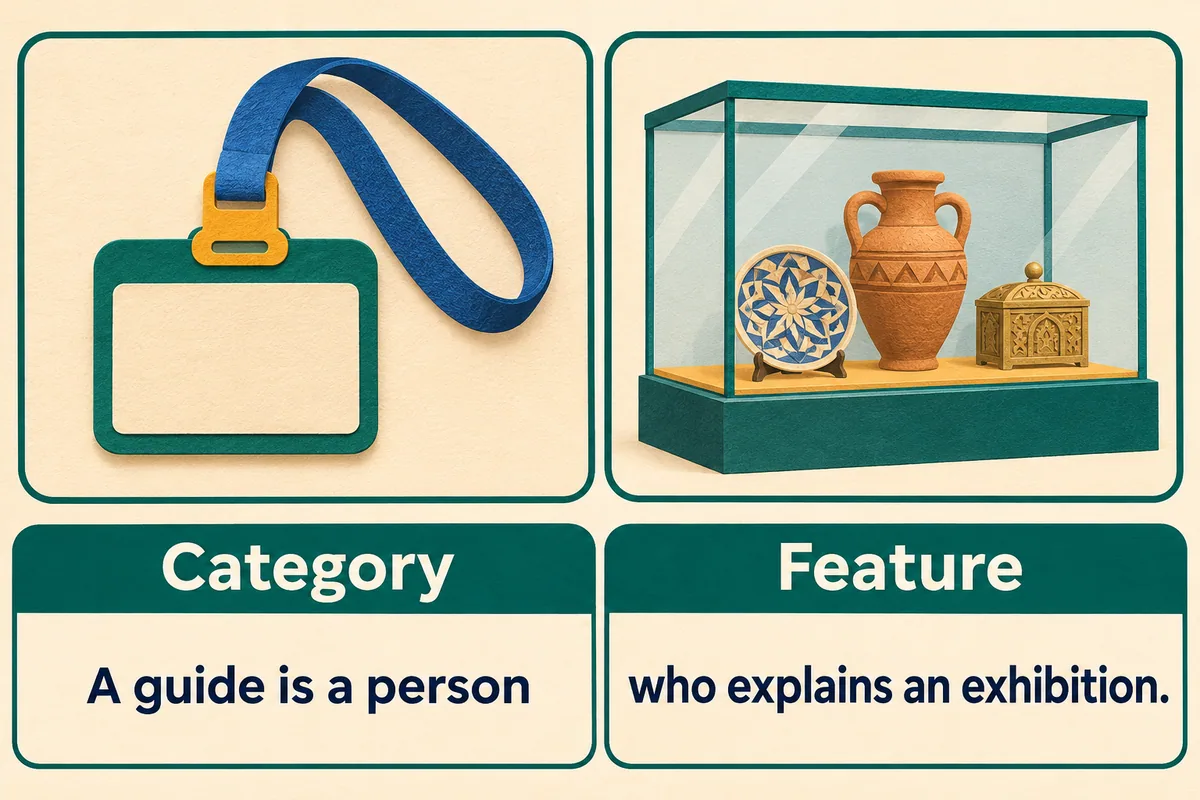
Start with a broad group. Then add the feature that separates the term from other items in that group. « A bilingual guide is a person who explains places or exhibitions in two languages. » For abstract terms, use means or refers to. « Cultural diversity refers to the variety of cultural backgrounds within a society. »
How do you complain and apologise politely?
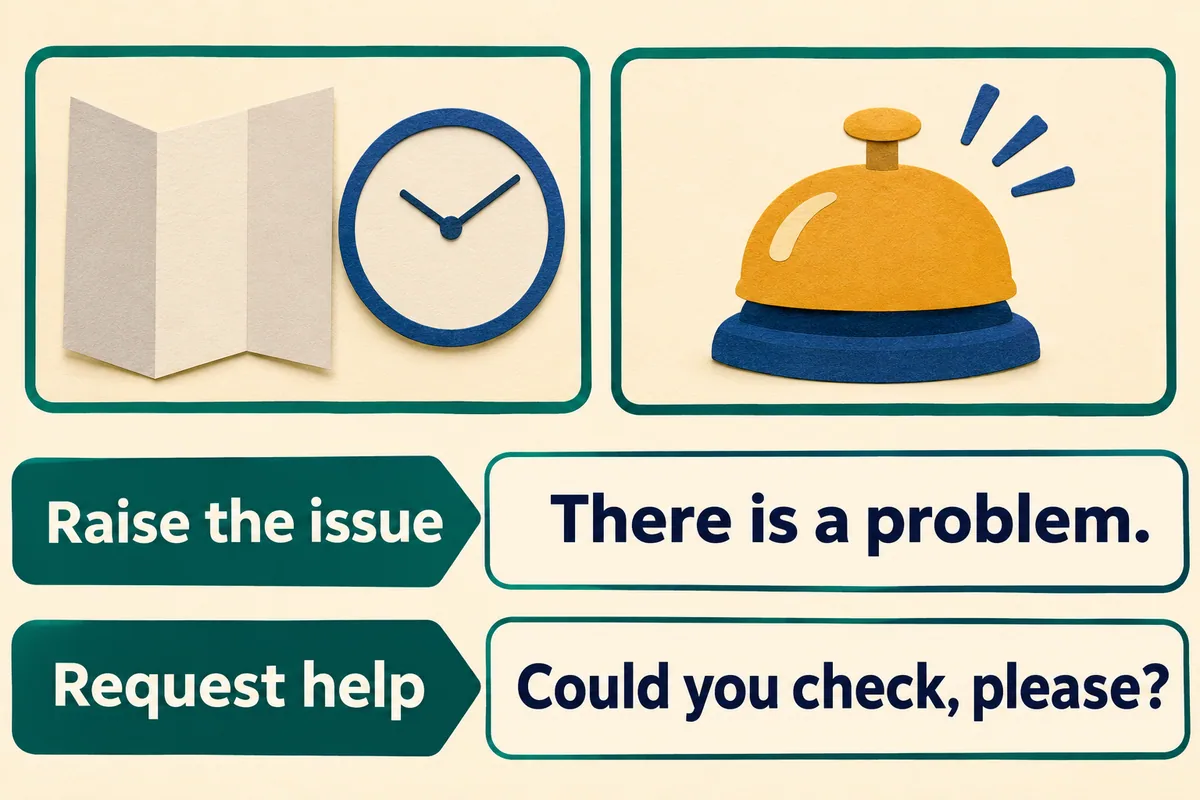
| Function | Useful phrase | Example |
|---|---|---|
| Raise a problem | I’m afraid there’s a problem with … | I’m afraid there’s a problem with the translation on this sign. |
| Request a remedy | Could you check …, please? | Could you check the opening time, please? |
| Apologise | I’m sorry about + noun / for + verb-ing | I’m sorry for putting the old sign back. |
| Offer a solution | I’ll … / Would … work for you? | I’ll print an updated sign this afternoon. |
| Accept the apology | Thanks for sorting it out. | Thanks for sorting it out. I’ll tell the other visitors. |
Role-play a museum visit
Step by step
Visitor and staff member
- The visitor explains that the brochure gave the wrong starting time for a tour.
- The staff member apologises, checks the next tour and offers a choice.
- Switch roles and try a more formal version using « I apologise for … ».
Remember
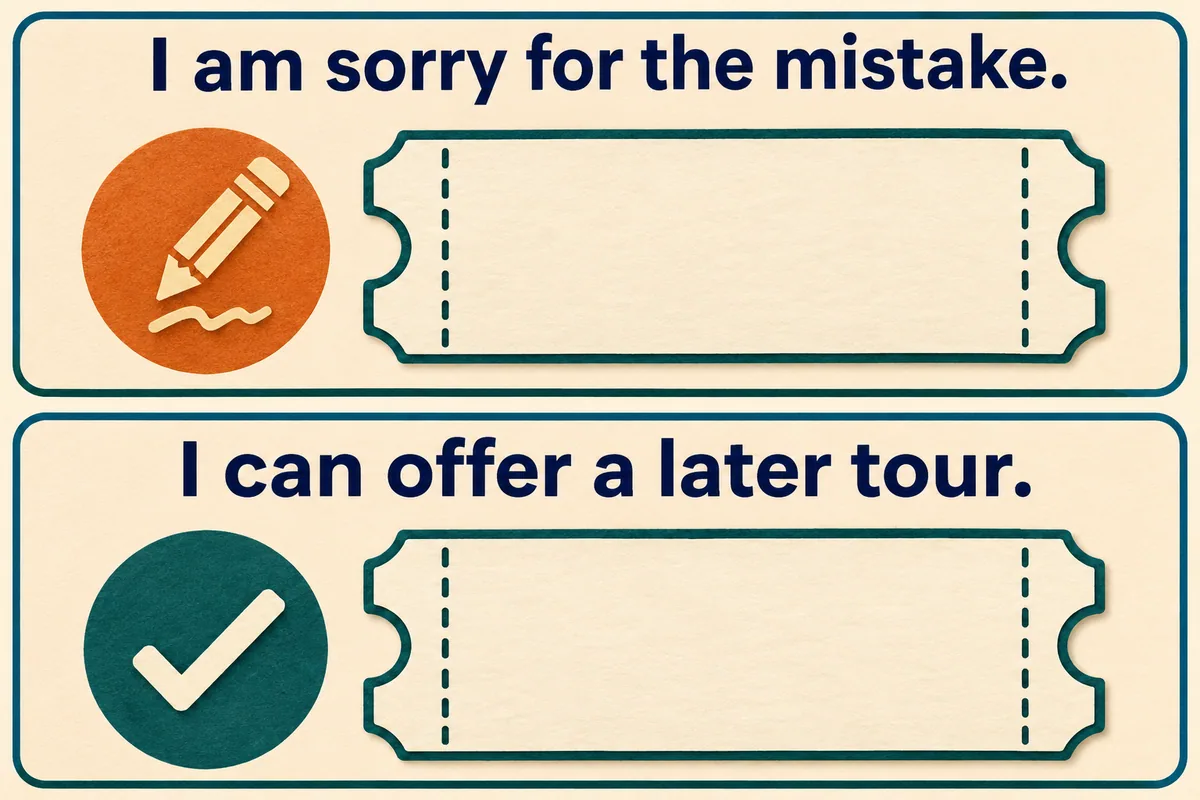
« I’m sorry to hear that » shows sympathy for someone’s news. Use « I’m sorry for the mistake » when taking responsibility.
Worked examples: definitions, complaints and apologies
Writing a definition
Define the word souk for a foreign visitor.
- Start with the general category: a souk is a kind of market.
- Add the feature that makes it different, with a relative clause: « where traders sell food, crafts and clothes from small stalls ».
- Add a detail if it helps: « often in the old part of a town or on a fixed day of the week ».
- Final definition: « A souk is a traditional market where traders sell food, crafts and clothes from small stalls, often in the old part of a town. »
From a rude complaint to a polite one
A customer says « This tagine is cold! Bring another one! » Make the complaint polite, then write the waiter’s apology.
- Soften the opening with Excuse me and I’m afraid: « Excuse me, I’m afraid my tagine is cold. »
- Replace the order with a polite request: « Could you warm it up, please? »
- The waiter apologises and offers a remedy: « I’m so sorry about that. I’ll bring you a hot one right away. »
- The customer accepts: « Thank you, that’s very kind. »
Listening and speaking practice
Listen to the recording and answer this question. What was the complaint, and which two solutions were offered?
Play the visitor and the receptionist. Make a complaint, apologise and agree on a solution.
Sources and curriculum
- English Language Guidelines for Secondary Schools (Ministry of Education, 2007)
The 2nd Baccalaureate syllabus describes the ten themes, four skills and language structures. See printed pages 76–84.
- National Baccalaureate Exam Specifications (English, 2025)
Reproduction of the national framework for the reading, language and writing sections, including the science streams.
Frequently asked questions
What expressions can I use to make a polite complaint in English?
How do you respond to an apology in English?
Exercises with answers
5 exercises, from easy practice to challenges. Try each one yourself, then reveal the answer and explanation.
Exercise 1
EasySay whether each sentence defines, complains, apologises or accepts an apology.
- « I’m afraid the room is too noisy to sleep. »
- « Please accept our apologies for the delay. »
- « A henna night is a party before a wedding at which the bride’s hands are decorated. »
- « Don’t worry, these things happen. »
- « I’m sorry, it was my fault. »
Answer and explanation
- It complains.
- It apologises.
- It defines.
- It accepts an apology.
- It apologises.
Exercise 2
Intermediate- Define a tradition without using the word traditional.
- A visitor says, « My guidebook has the wrong map. » Apologise and suggest a remedy.
Answer and explanation
- A tradition is a practice or belief passed from one generation to another.
- One answer is « I’m sorry for the mistake. I can give you an updated map at the desk. »
Exercise 3
IntermediateDefine each word with who, which or where.
- a host
- a caftan
- a hammam
- an immigrant
- a festival
Answer and explanation
- A host is a person who receives and looks after guests.
- A caftan is a long, loose dress which is often embroidered and worn on special occasions.
- A hammam is a public steam bath where people go to wash and relax.
- An immigrant is a person who comes to live permanently in another country.
- A festival is an event, often held every year, where people celebrate something with music, food or performances.
Exercise 4
Intermediate- What was the complaint, and which two solutions were offered?
Answer and explanation
- The tickets gave a different time. The receptionist offered an audio guide or a place on the next tour.
Exercise 5
ChallengeA guest booked a room with two beds but was given a room with one bed. Write each line.
- The guest makes a polite complaint.
- The receptionist apologises and asks for a detail.
- The guest gives the detail.
- The receptionist offers a solution.
- The guest accepts the apology and the solution.
Answer and explanation
- « Excuse me, I’m afraid there’s a problem with my room. I booked a room with two beds, but there’s only one. »
- « I’m very sorry about that. Could you tell me your room number, please? »
- « It’s room 214. »
- « I apologise for the mistake. We have a twin room on the third floor, and I’ll ask someone to help you with your bags. »
- « That’s fine, thank you for sorting it out so quickly. »