



Writing an Informal Letter
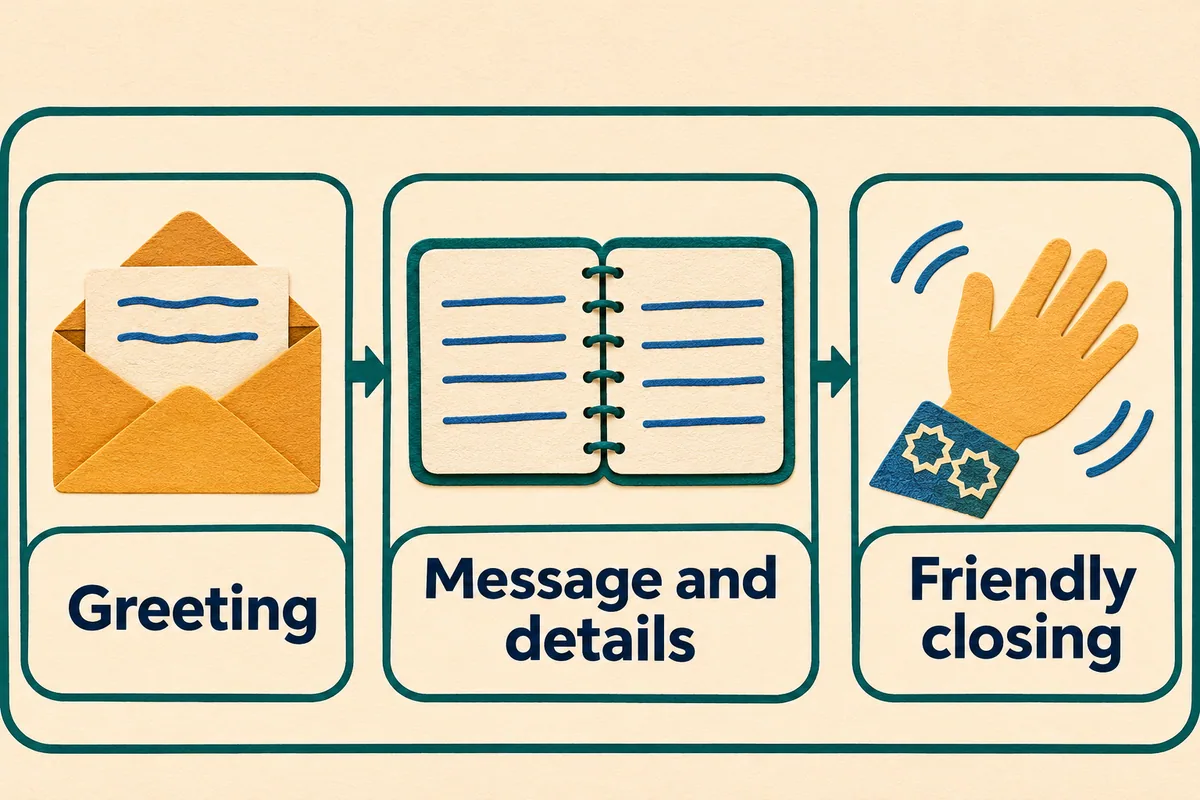
An informal letter to a friend opens with a friendly greeting, explains why you are writing, and answers the prompt in clear paragraphs. Close with a short personal line and a suitable sign-off.
By the end of this lesson, you can
- Write an informal letter or reply to a friend.
- Choose vocabulary and tone for a familiar reader.
Un bon cours, ça se partage.
What is the structure of an informal letter?
Step by step
Plan for a reply
- Greet the reader with « Dear Lina » or « Hi Lina ».
- Refer to their message and state your reason for writing.
- Give a practical detail or example for each point in the prompt.
- Finish with a personal line and a sign-off such as « Best wishes ». Follow any exam instruction about names or signatures.
Model · A letter to a friend visiting Morocco
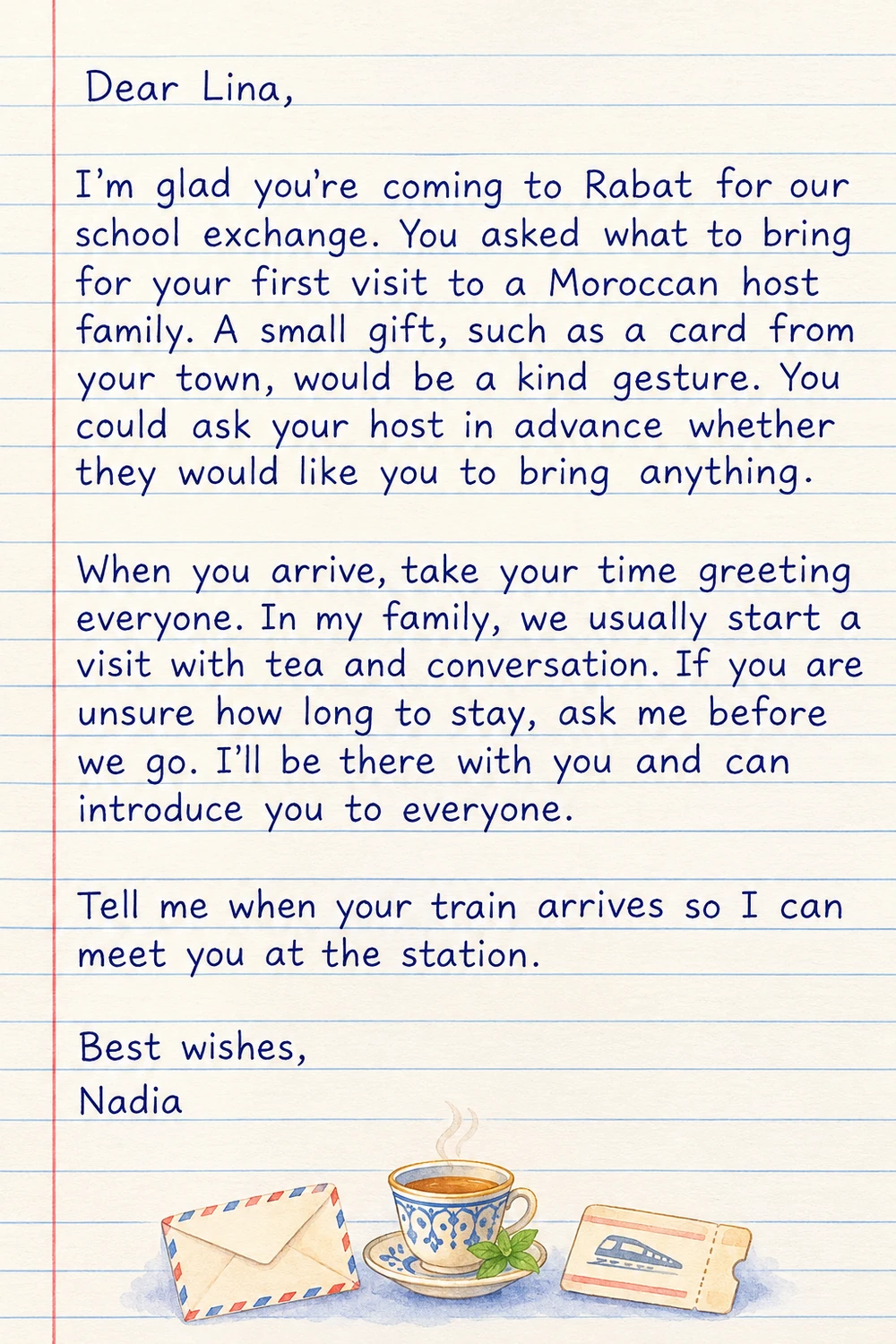
Dear Lina,
I’m glad you’re coming to Rabat for our school exchange. You asked what to bring for your first visit to a Moroccan host family. A small gift, such as a card from your town, would be a kind gesture. You could ask your host in advance whether they would like you to bring anything.
When you arrive, take your time greeting everyone. In my family, we usually start a visit with tea and conversation. If you are unsure how long to stay, ask me before we go. I’ll be there with you and can introduce you to everyone.
Tell me when your train arrives so I can meet you at the station.
Best wishes,
Nadia
Adapt the model to the prompt
Use short contractions such as I’m and you’re when the reader is a friend. Give specific advice and a reason, and avoid assuming that every family follows the same custom. For an email reply, keep the friendly opening and answer each question in the message.

Worked examples: writing to a friend
From formal to friendly
Rewrite « I am writing to inform you that I will arrive on Friday » for a friend.
- Replace the formal opening with a friendly one: « Just a quick note to say … ».
- Use contractions and a more natural verb form: « I’m arriving ».
- Add a personal touch: an exclamation or a feeling.
- Final version: « Just a quick note to say I’m arriving on Friday. I can’t wait to see you! »
Answering every question in a friend’s letter
Your friend asks: when are your exams, what are you doing this summer, and can I visit in July?
- Plan one short paragraph per question, in the order your friend asked them.
- Paragraph 1: « My exams finish on 12 June, so I’ll be free after that. »
- Paragraph 2: « This summer, I’m helping my uncle at his shop in Agadir for a month. »
- Paragraph 3: « Of course you can visit in July! We could spend a few days at the beach together. »
Sources and curriculum
- English Language Guidelines for Secondary Schools (Ministry of Education, 2007)
The 2nd Baccalaureate syllabus describes the ten themes, four skills and language structures. See printed pages 76–84.
- National Baccalaureate Exam Specifications (English, 2025)
Reproduction of the national framework for the reading, language and writing sections, including the science streams.
Frequently asked questions
How do I start and end an informal letter in English?
Can I use contractions in an informal letter?
Exercises with answers
4 exercises, from easy practice to challenges. Try each one yourself, then reveal the answer and explanation.
Exercise 1
EasySay whether each expression belongs in an informal or a formal letter.
- « Lots of love, »
- « Yours sincerely, »
- « Guess what? »
- « I would be grateful if you could … »
- « Can’t wait to see you! »
Answer and explanation
- Informal.
- Formal.
- Informal.
- Formal.
- Informal.
Exercise 2
Intermediate- A friend will attend a school celebration and asks what to wear and when to arrive. Write a reply that answers both questions.
Answer and explanation
- One answer is « Hi Adam, I’m glad you can come. Wear something comfortable because we’ll spend part of the event outside. Please arrive at half past four so I can show you where to leave your bag. See you on Friday! Best wishes, »
Exercise 3
IntermediateRewrite each sentence for a letter to a friend.
- « I was delighted to receive your letter. »
- « I regret that I am unable to attend. »
- « Please inform me of your arrival time. »
- « I look forward to your reply. »
- « I would recommend that you bring warm clothes. »
Answer and explanation
- « It was great to hear from you! »
- « I’m really sorry I can’t make it. »
- « Let me know when you’re arriving. »
- « Write back soon! »
- « You should bring a warm jumper. »
Exercise 4
ChallengeYour pen friend Emma, from Canada, will spend Eid al-Fitr with your family. She asks what happens on the day and how she should behave. Write an informal letter of about 120 words.
- Write your letter.
Answer and explanation
- Possible answer: « Dear Emma, I’m so happy you’re spending Eid with us! It’s my favourite day of the year. In the morning, many people go to the mosque for the Eid prayer, and then we have breakfast together with msemen and mint tea. After that, we visit my grandparents and our neighbours, and everyone wears new or traditional clothes. Don’t worry about what to wear: I’ll lend you one of my caftans. When you meet people, just say « Eid Mubarak » and smile. Older relatives might offer you pastries again and again, so take a small piece each time. That’s the best way to be polite! Let me know if you have any other questions. I can’t wait to see you. Lots of love, Salma »