



Phrasal Verbs
A phrasal verb combines a verb with a particle, as in turn down or look after. Learn the meaning of the whole expression and check whether an object can go between its parts.
By the end of this lesson, you can
- Interpret phrasal verbs from context.
- Place nouns and pronouns correctly with separable verbs.
Un bon cours, ça se partage.
What does the particle add to the verb?
| Particle or pattern | Example | Meaning in this context |
|---|---|---|
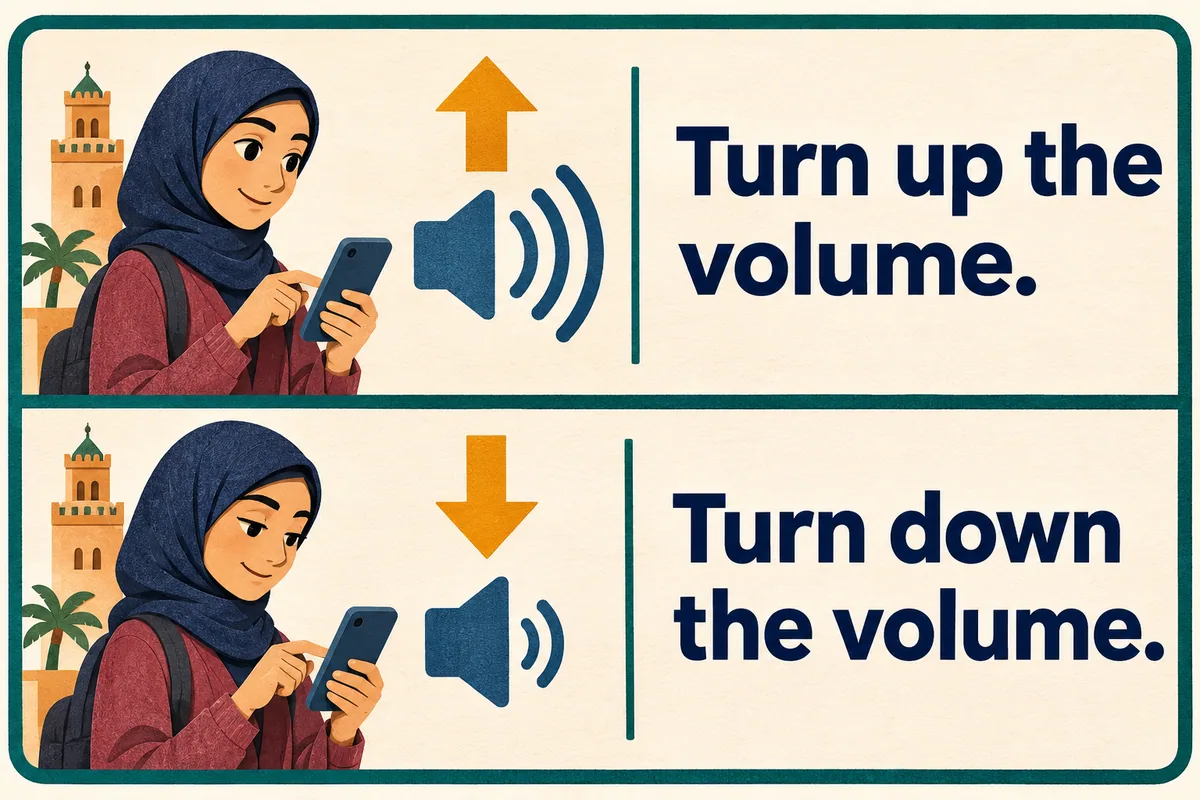
| up can suggest an increase | Turn up the volume. | increase the volume |
| down can suggest a decrease | Turn down the volume. | reduce the volume |
| back can suggest a return | Bring the guidebook back tomorrow. | return with it |
| out can suggest discovery | We found out when the museum opens. | discovered |
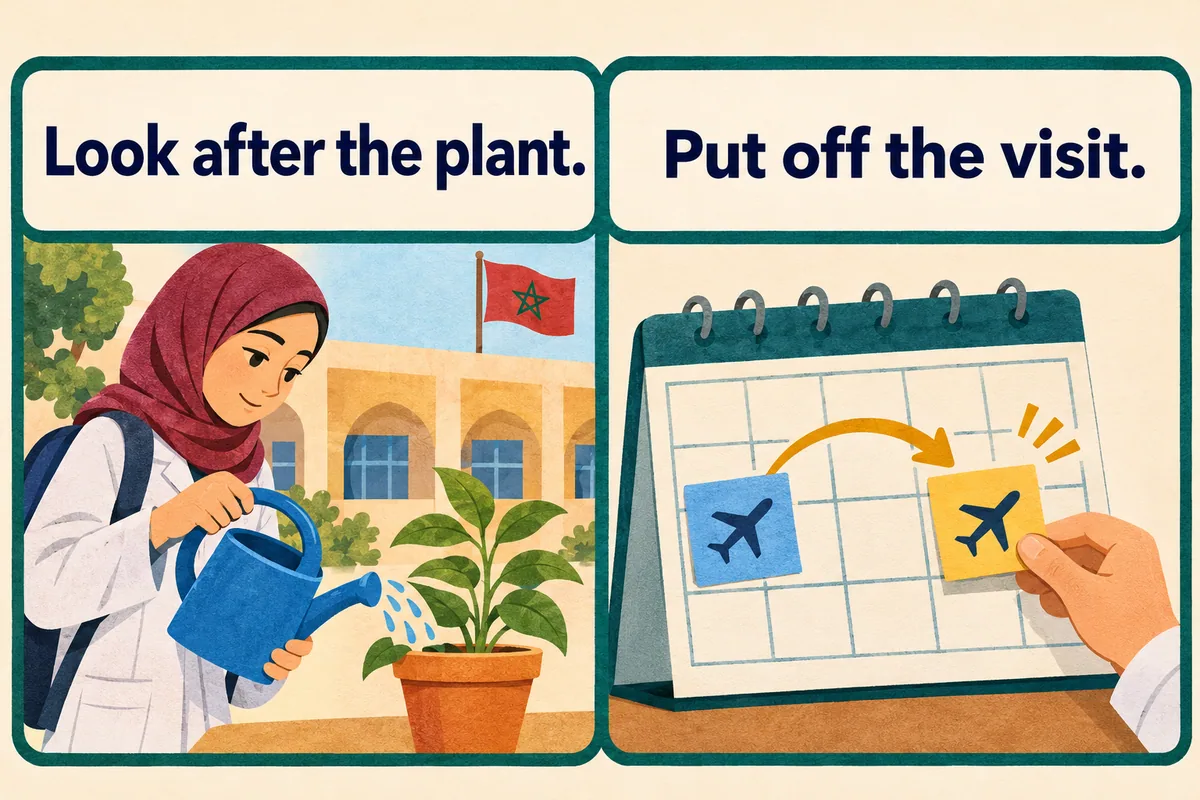
| meaning learned as a whole | They put off the visit. | postponed the visit |
Separable and inseparable phrasal verbs
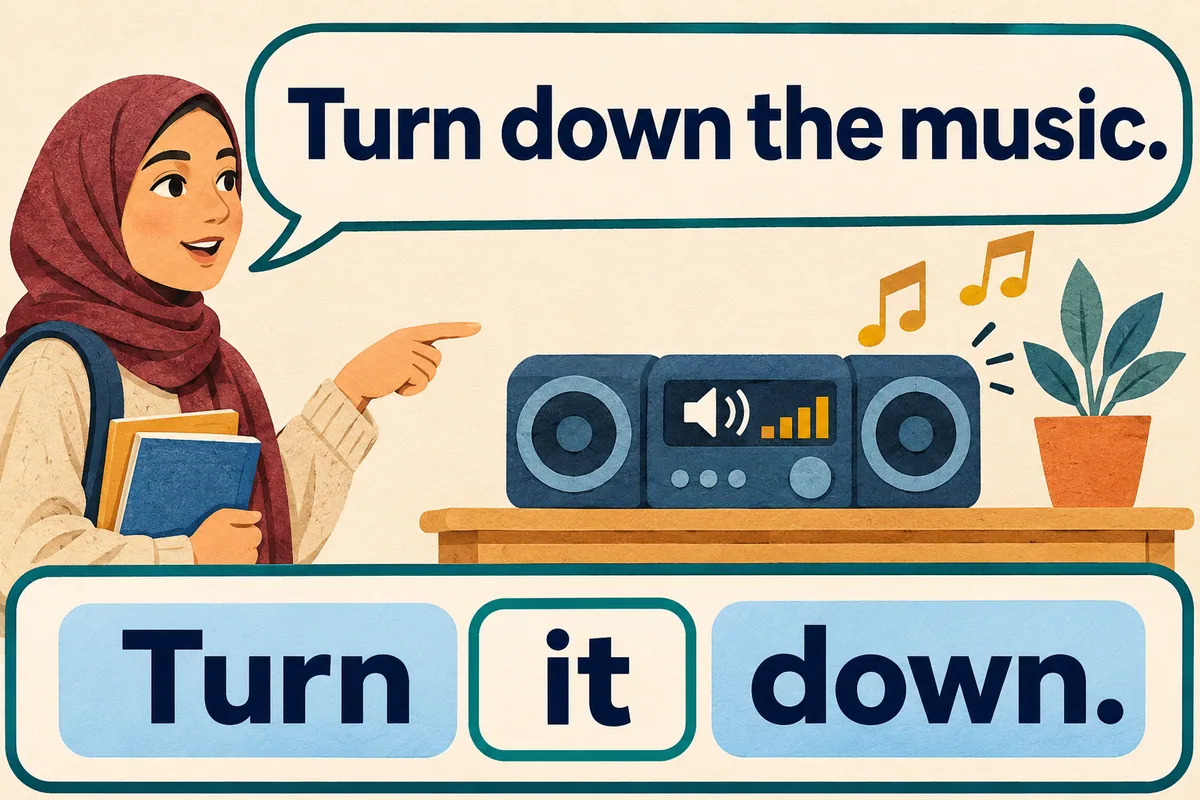
With a separable verb and a noun, both « turn down the music » and « turn the music down » are possible. With a pronoun, say « turn it down ». In « look after the guests », the object follows the whole expression. When there is no direct object, as in « the visitors showed up », there is nothing to move.
In three-part expressions such as « look forward to the visit » or « put up with the noise », keep the parts together. In look forward to, to is a preposition, so it can be followed by verb-ing.
Choose by meaning and by grammar
« The committee turned down the proposal » means it rejected it. Context tells you whether turn down means reject or reduce. In an exam gap, check the tense too. The visitors ran out of time yesterday, so the verb takes a past form.
Worked examples: understanding and using phrasal verbs
Guessing the meaning from context
What does called off mean in « The open-air concert was called off because of the storm »?
- Look at the cause: a storm. What usually happens to an outdoor event in a storm?
- Test a meaning in the sentence: « The open-air concert was cancelled because of the storm. » It makes sense.
- Answer: call off means cancel. The past participle in the passive is called off.
Placing the object
Put the object the children, then them, into « She picked up ».
- Pick up is separable, so a noun can go after the particle or between the two parts: « She picked up the children » or « She picked the children up ».
- A pronoun must go between the verb and the particle: « She picked them up ». « She picked up them » is wrong.
- Compare an inseparable verb: « She looks after them ». « She looks them after » is wrong.
Sources and curriculum
- English Language Guidelines for Secondary Schools (Ministry of Education, 2007)
The 2nd Baccalaureate syllabus describes the ten themes, four skills and language structures. See printed pages 76–84.
- National Baccalaureate Exam Specifications (English, 2025)
Reproduction of the national framework for the reading, language and writing sections, including the science streams.
Frequently asked questions
Where does the pronoun go in a separable phrasal verb?
What is a phrasal verb?
Exercises with answers
4 exercises, from easy practice to challenges. Try each one yourself, then reveal the answer and explanation.
Exercise 1
EasyChoose the meaning from the box: postpone, discover, become an adult, stop trying, wait for with pleasure.
- grow up
- give up
- put off
- find out
- look forward to
Answer and explanation
- Become an adult.
- Stop trying.
- Postpone.
- Discover.
- Wait for with pleasure.
Exercise 2
Intermediate- Replace the object in « They put off the event » with it.
- Complete with a past-tense phrasal verb meaning discovered. « Yesterday we ___ that the tour was free. »
- Rewrite « I’m looking forward to meet your family ».
Answer and explanation
- They put it off. Put off is separable.
- Found out. The time word yesterday calls for the past simple.
- I’m looking forward to meeting your family. The preposition to takes an -ing form here.
Exercise 3
IntermediateReplace the words in brackets with a phrasal verb in the correct tense.
- They (postponed) the trip to Merzouga.
- We (discovered) that the museum was closed on Mondays.
- My grandmother (raised) six children.
- Please (continue) working while I answer the phone.
- The plane (left the ground) at eight o’clock.
- I can’t (tolerate) this noise any longer.
Answer and explanation
- Put off.
- Found out.
- Brought up.
- Carry on (or go on).
- Took off.
- Put up with.
Exercise 4
ChallengeReplace the words in italics with a pronoun and put it in the right place. Say whether the phrasal verb is separable.
- Turn down the music, please.
- She looked after her little brothers.
- He gave up football last year.
- We are looking forward to the holidays.
- They called off the meeting.
Answer and explanation
- Turn it down, please. Separable.
- She looked after them. Inseparable.
- He gave it up last year. Separable.
- We are looking forward to them. Three-part verb, so the parts stay together.
- They called it off. Separable.