



Relative Pronouns and Defining and Non-defining Clauses
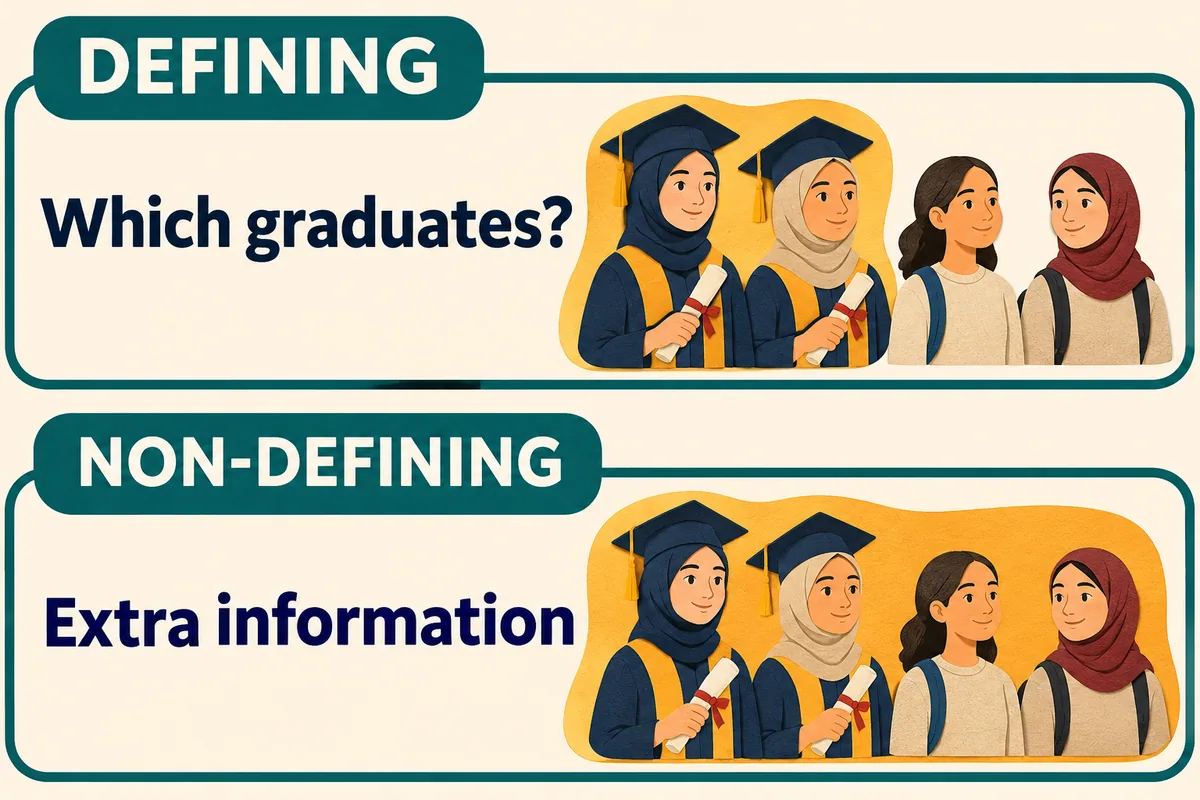
A defining relative clause identifies which person or thing you mean. A non-defining relative clause adds information about someone or something already identified and is set off with commas.
By the end of this lesson, you can
- Choose a relative word based on the noun and the role within the clause.
- Use punctuation, that and pronoun omission correctly.
Un bon cours, ça se partage.
Which relative word should I choose?
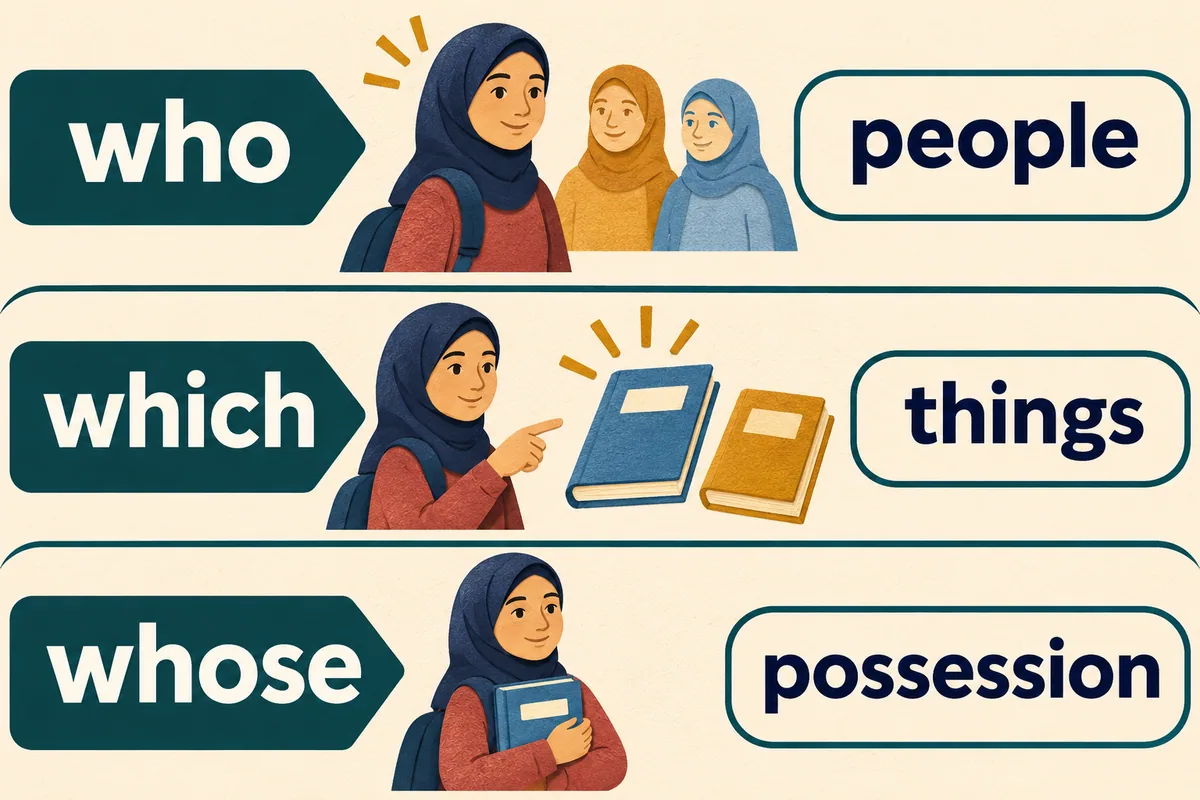
| Word | Use | Example |
|---|---|---|
| who / whom | people. Whom is a formal object form | The engineer who led the trial wrote a report. |
| which | things and animals | The scholarship which I applied for covers travel. |
| that | people or things in defining clauses | The study that explains the figures is online. |
| whose | possession or relationship | The student whose mentor moved abroad found a new adviser. |
| where / when | place or time | The lab where she trained offers short courses. |
Defining or non-defining relative clauses
« Graduates who train abroad may bring back new skills » refers to the graduates who train abroad. « The graduates, who trained abroad, returned in June » refers to an already identified group and adds a detail about all its members. Use commas around the extra information, and use who or which rather than that in this type of clause.
When can you leave out the relative pronoun?
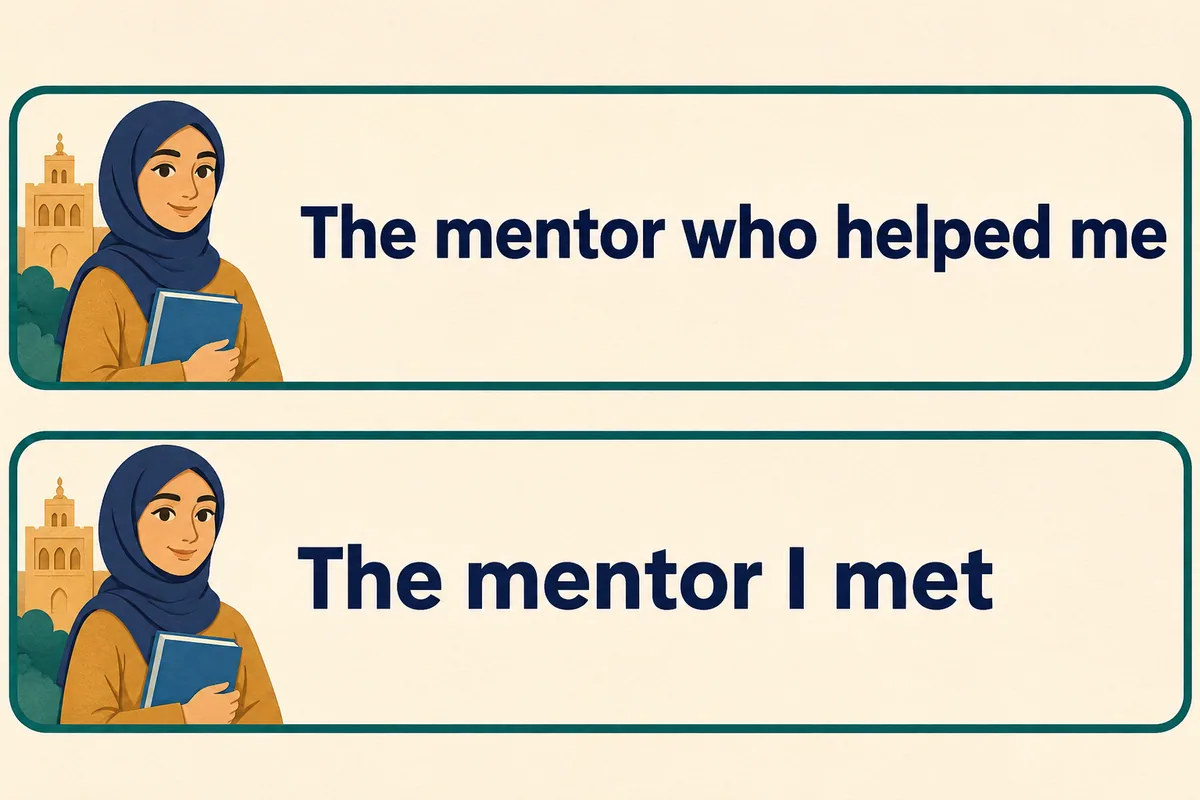
You can leave out an object pronoun in a defining clause, as in « The mentor I met is an engineer. » I is the subject of met. Keep a pronoun that acts as the subject, as in « The mentor who helped me is an engineer. » Keep the pronoun in a non-defining clause.
Remember
Avoid repeating the object. Write « the course that we took », with that doing the work of the object.
Worked examples: joining sentences with relative clauses
Joining two sentences
Join « The engineer moved to Canada. He had studied in Rabat. »
- Find the noun the two sentences share: the engineer, repeated by he.
- Replace he with a relative pronoun for a person: who.
- Put the relative clause directly after the noun it describes: « The engineer who had studied in Rabat moved to Canada. »
When commas change the meaning
Compare « My brother who lives in Paris is a doctor » and « My brother, who lives in Paris, is a doctor. »
- Without commas, the clause is defining: it tells you which brother, so the speaker has more than one.
- With commas, the clause is non-defining: it adds extra information about the only brother.
- Read the context before you decide where commas go.
Sources and curriculum
- English Language Guidelines for Secondary Schools (Ministry of Education, 2007)
The 2nd Baccalaureate syllabus describes the ten themes, four skills and language structures. See printed pages 76–84.
- National Baccalaureate Exam Specifications (English, 2025)
Reproduction of the national framework for the reading, language and writing sections, including the science streams.
Frequently asked questions
When can I use that instead of who or which?
When do we use whose in English?
Exercises with answers
4 exercises, from easy practice to challenges. Try each one yourself, then reveal the answer and explanation.
Exercise 1
EasyComplete each sentence with who, which, whose, where or when.
- The doctor ___ treated my grandmother now works in Germany.
- This is the laboratory ___ she did her research.
- The student ___ project won the prize got a scholarship.
- 2019 was the year ___ my cousin left for Canada.
- The app ___ I use to learn languages is free.
Answer and explanation
- Who.
- Where.
- Whose.
- When.
- Which (or that).
Exercise 2
Intermediate- The graduate returned last year. Her project won a prize. Join using whose.
- The exchange programme is next month. It was announced on Friday. Add the second fact as extra information.
- In « The person who called me » and « The person who I called », which who can you omit?
Answer and explanation
- The graduate whose project won a prize returned last year.
- The exchange programme, which was announced on Friday, is next month.
- You can omit who in « The person I called », where it is the object. Keep it in « the person who called me », where it is the subject.
Exercise 3
IntermediateJoin each pair with a relative pronoun. Add commas when the information is extra.
- I met a nurse. She works in a hospital in Lyon.
- Casablanca is Morocco’s biggest city. It has a busy port.
- The scientist gave a talk. Her book was translated into Arabic.
- The company hired three engineers. They had studied abroad.
- My uncle lives in Montreal. He visits us every summer.
Answer and explanation
- I met a nurse who works in a hospital in Lyon.
- Casablanca, which has a busy port, is Morocco’s biggest city.
- The scientist whose book was translated into Arabic gave a talk.
- The company hired three engineers who had studied abroad.
- My uncle, who visits us every summer, lives in Montreal. Commas show that I mean my only uncle, or one already identified.
Exercise 4
ChallengeFor each sentence, add commas if needed, say whether the clause is defining or non-defining, and say whether the relative pronoun can be left out.
- The graduates who return often start their own companies.
- Rabat which is the capital has several universities.
- The book that I borrowed is about migration.
- Dr Alami who trained in Paris now runs the clinic.
- The job that she accepted is in Dubai.
Answer and explanation
- No commas. Defining. Who is the subject, so it cannot be left out.
- Rabat, which is the capital, has several universities. Non-defining. The pronoun cannot be left out.
- No commas. Defining. That is the object, so it can be left out: « The book I borrowed is about migration. »
- Dr Alami, who trained in Paris, now runs the clinic. Non-defining. The pronoun cannot be left out.
- No commas. Defining. That is the object, so it can be left out: « The job she accepted is in Dubai. »