



Cultural Values Vocabulary
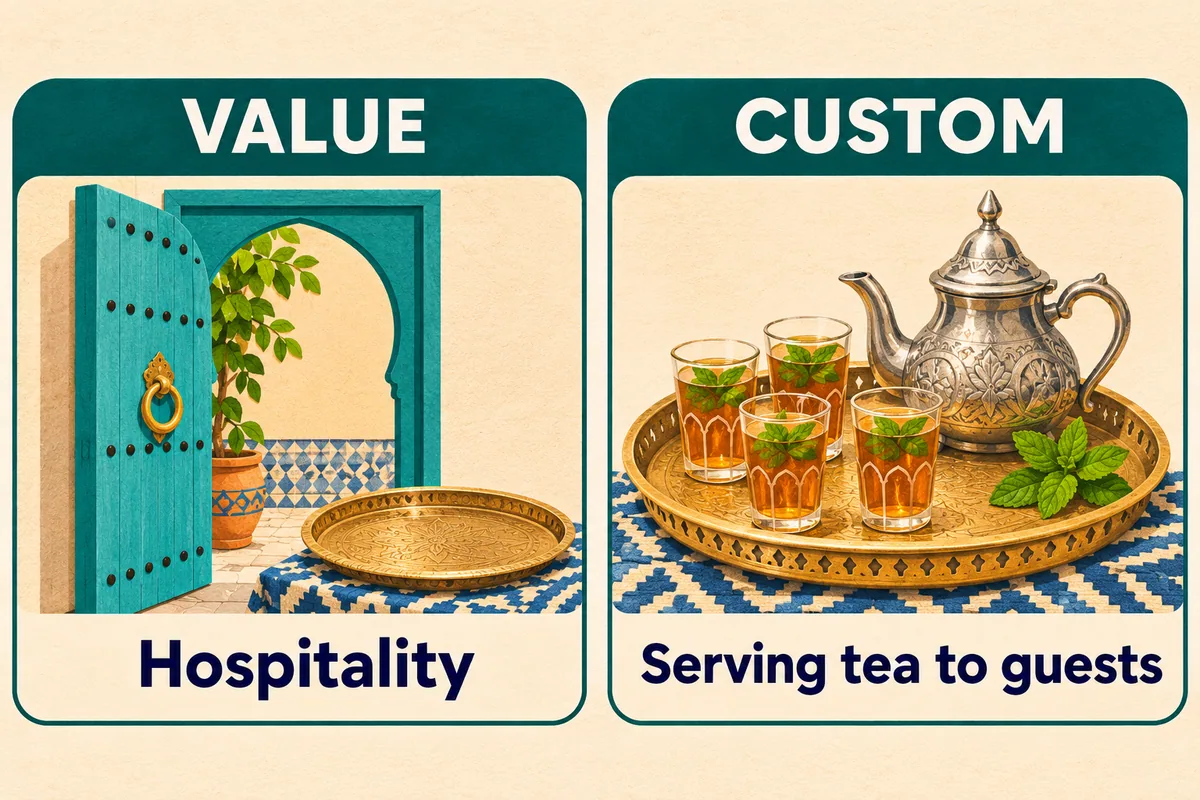
Cultural values are ideas about what matters to a group, such as hospitality or respect for elders. Customs are shared practices, such as how visitors are welcomed. Unit 6 of English 2 Bac uses these terms to compare practices and explain their meaning.
By the end of this lesson, you can
- Distinguish values, customs and heritage.
- Use cultural vocabulary and collocations in context.
Un bon cours, ça se partage.
What are cultural values and customs?
| Term | Meaning | Use it in a sentence |
|---|---|---|
| custom | a practice shared by a community | Serving tea to guests is a familiar custom in many Moroccan homes. |
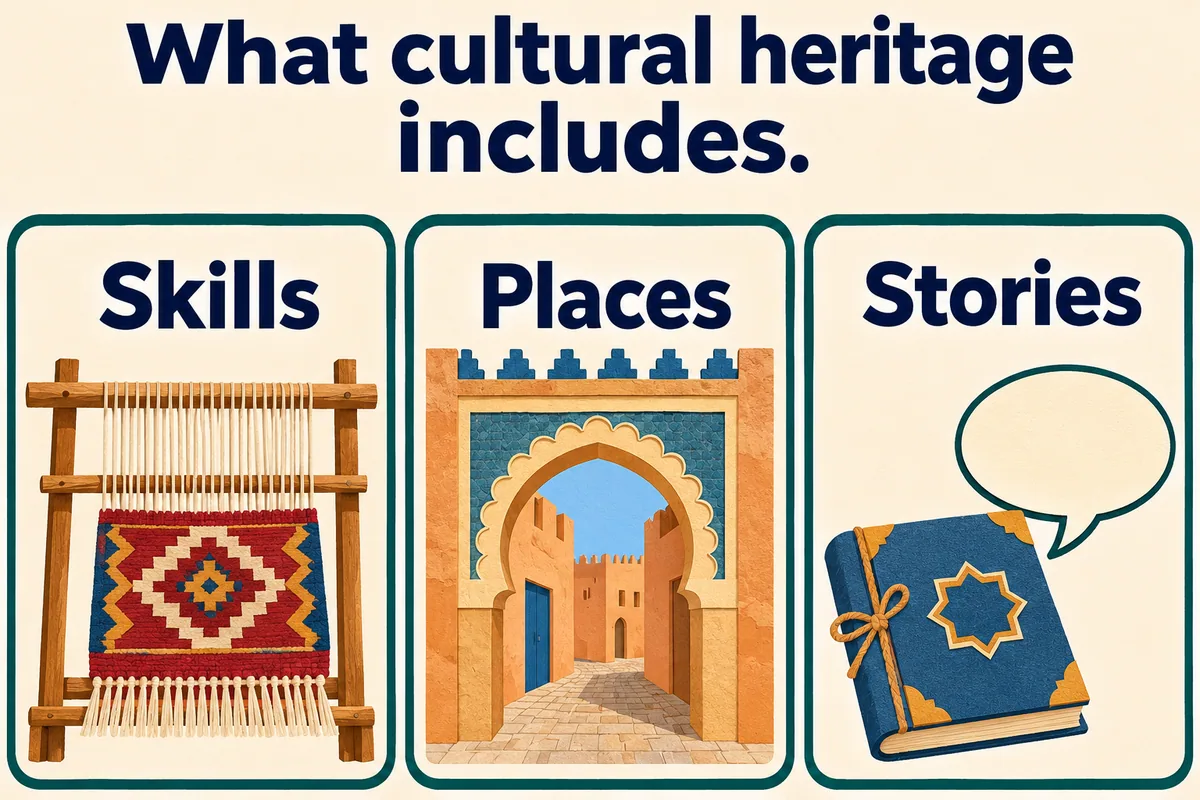
| heritage | practices, places and objects passed down over time | Traditional weaving is part of the region’s cultural heritage. |
| identity | the qualities and experiences that shape a sense of who we are | A person’s identity can include more than one language. |
| diversity | the presence of different backgrounds or ways of life | The festival celebrates linguistic diversity. |
| stereotype | a fixed, oversimplified idea about a whole group | The interview challenges a stereotype about young people. |
| hospitality | a welcoming attitude towards guests | Our hosts showed hospitality by making time for our questions. |
Collocations and word families
Useful combinations include preserve heritage, observe a tradition, challenge a stereotype, show respect for and learn about other cultures. Use diverse to describe a group and diversity to name the variety within it. A tolerant person respects differences. Intolerance means refusing to accept them.
Compare customs with careful wording
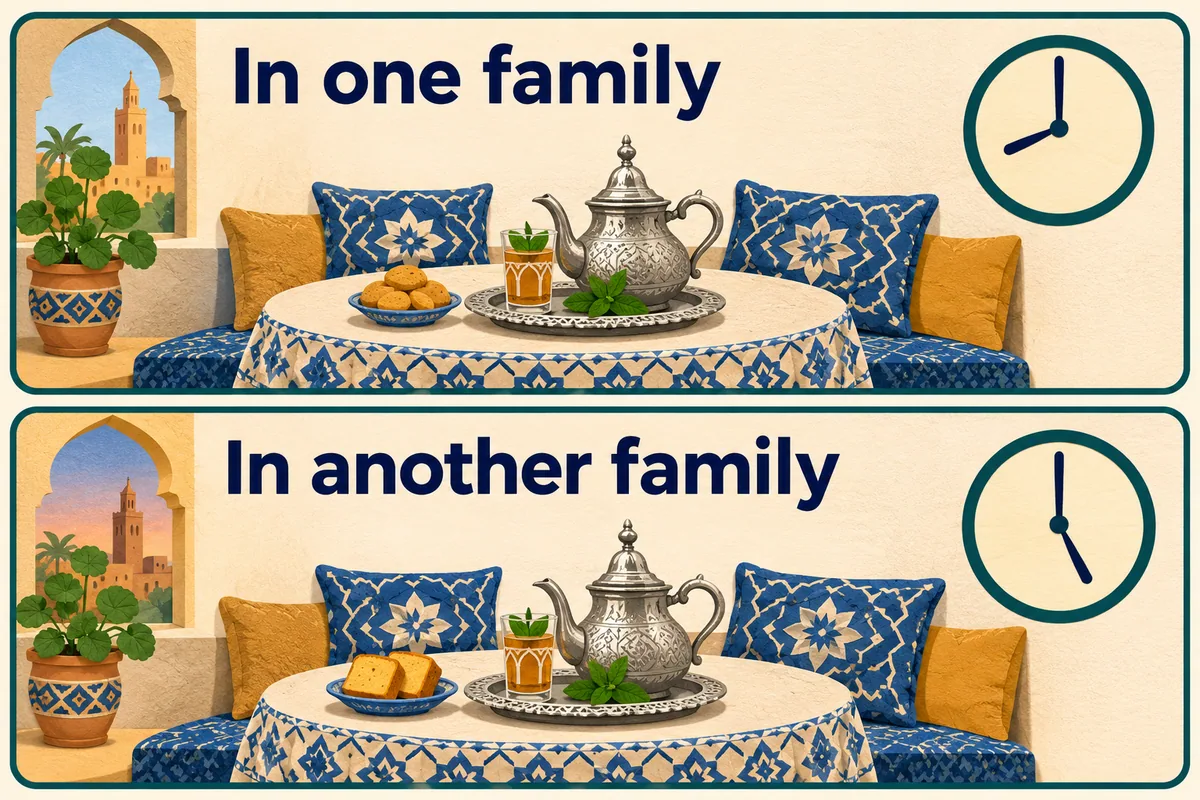
A practice can vary by family, place and occasion. Name the setting and explain what you observed. For example, « Some hosts in my neighbourhood serve tea at the start of a visit. In my friend’s family, tea is usually served later. In both homes it offers people time to talk. »
Worked examples: values, customs and heritage
Value or custom?
Classify: respect for elders, standing up when an older relative enters the room, hospitality, serving mint tea to guests.
- A value is an idea about what matters. Respect for elders and hospitality are values.
- A custom is a shared practice that people do. Standing up for an older relative and serving mint tea are customs.
- Link each custom to its value: « Standing up when an elder enters expresses respect, and serving mint tea expresses hospitality. »
Tangible or intangible heritage?
Give one example of each kind of heritage in Morocco.
- Tangible heritage is physical: buildings, monuments and objects. The medina of Fès, listed by UNESCO as a World Heritage site, is an example.
- Intangible heritage is a living practice: music, skills, festivals and oral traditions. Gnawa music, on UNESCO’s list of intangible cultural heritage, is an example.
- Write the answer as a comparison: « The medina of Fès can be visited, while Gnawa music lives through the people who perform and teach it. »
Sources and curriculum
- English Language Guidelines for Secondary Schools (Ministry of Education, 2007)
The 2nd Baccalaureate syllabus describes the ten themes, four skills and language structures. See printed pages 76–84.
- National Baccalaureate Exam Specifications (English, 2025)
Reproduction of the national framework for the reading, language and writing sections, including the science streams.
Frequently asked questions
What is the difference between a custom and cultural heritage?
What is the difference between tangible and intangible heritage?
Exercises with answers
4 exercises, from easy practice to challenges. Try each one yourself, then reveal the answer and explanation.
Exercise 1
EasyUse each word once: hospitality, heritage, identity, stereotype, diversity.
- Mint tea is a symbol of Moroccan ___.
- The medina of Fès is part of our cultural ___.
- Speaking Darija, Tamazight and French is part of many young Moroccans’ ___.
- The idea that all teenagers are lazy is a ___.
- The festival celebrates the ___ of cultures in the city.
Answer and explanation
- Hospitality.
- Heritage.
- Identity.
- Stereotype.
- Diversity.
Exercise 2
Intermediate- Use the correct form of diverse in « The exhibition celebrates cultural ___ ».
- Replace the unsupported generalisation « All visitors greet elders the same way ». Explain your change.
Answer and explanation
- Diversity. The sentence needs a noun after cultural.
- One answer is « In the two families we visited, younger guests greeted elders first. » This describes what was observed in those families.
Exercise 3
IntermediateGive the correct form of the word in brackets.
- Couscous is ___ (tradition) served on Fridays in many families.
- Essaouira is a ___ (culture) rich town.
- We should respect people from ___ (differ) backgrounds.
- Racism is a form of ___ (tolerant).
- ___ (globalise) has changed the way young people dress and eat.
Answer and explanation
- Traditionally. The adverb describes how it is served.
- Culturally. The adverb modifies the adjective rich.
- Different. The adjective describes backgrounds.
- Intolerance. After of, use a noun with a negative prefix.
- Globalisation. The gap is the subject, so it needs a noun.
Exercise 4
ChallengeAnswer each question in two or three sentences.
- Describe a celebration in your family. Name one custom and the value behind it.
- Rewrite the generalisation « Westerners don’t care about their families » as a careful, accurate statement.
- Why is it important to preserve intangible heritage? Give one reason and one example.
Answer and explanation
- One answer is « At Eid, my family visits my grandparents first thing in the morning. Younger people greet the elders before anyone else. This custom shows respect for older generations. »
- One answer is « Family life is organised differently from one country to another. In some families, grown-up children live far from their parents but keep in touch every day. »
- One answer is « Intangible heritage disappears if nobody learns it. For example, if young people stop learning traditional weaving, the skill and the stories linked to it may be lost. »