



Prefixes, Suffixes and Word Formation
A prefix comes before a base word, as in rewrite. A suffix comes after it, as in cooperation or helpful. In an English 2 Bac word formation exercise, use the words around the gap to decide which word class and meaning are needed.
By the end of this lesson, you can
- Identify the effects of common prefixes and suffixes.
- Choose a form from meaning, word class and sentence structure.
Un bon cours, ça se partage.
Prefixes that change meaning
| Prefix | Common meaning | Examples |
|---|---|---|
| un-, in-, im-, dis- | negative or opposite, depending on the base | unfair, inactive, impossible, disagree |
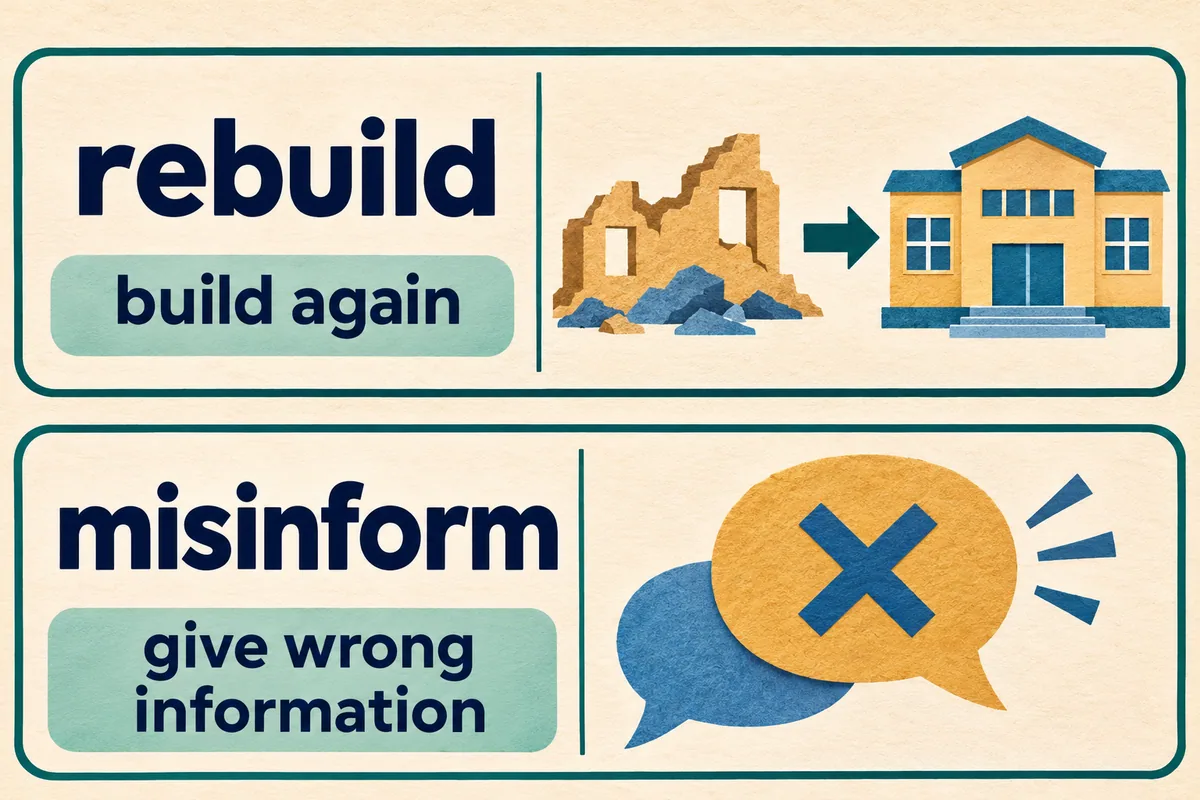
| re- | again | rebuild, reorganise |
| mis- | wrongly | misunderstand, misinform |
| inter- | between or among | international, interschool |
| co- | joint or together | cooperate, co-author |
Suffixes and the word class you need
| Target | Examples | Sentence clue |
|---|---|---|
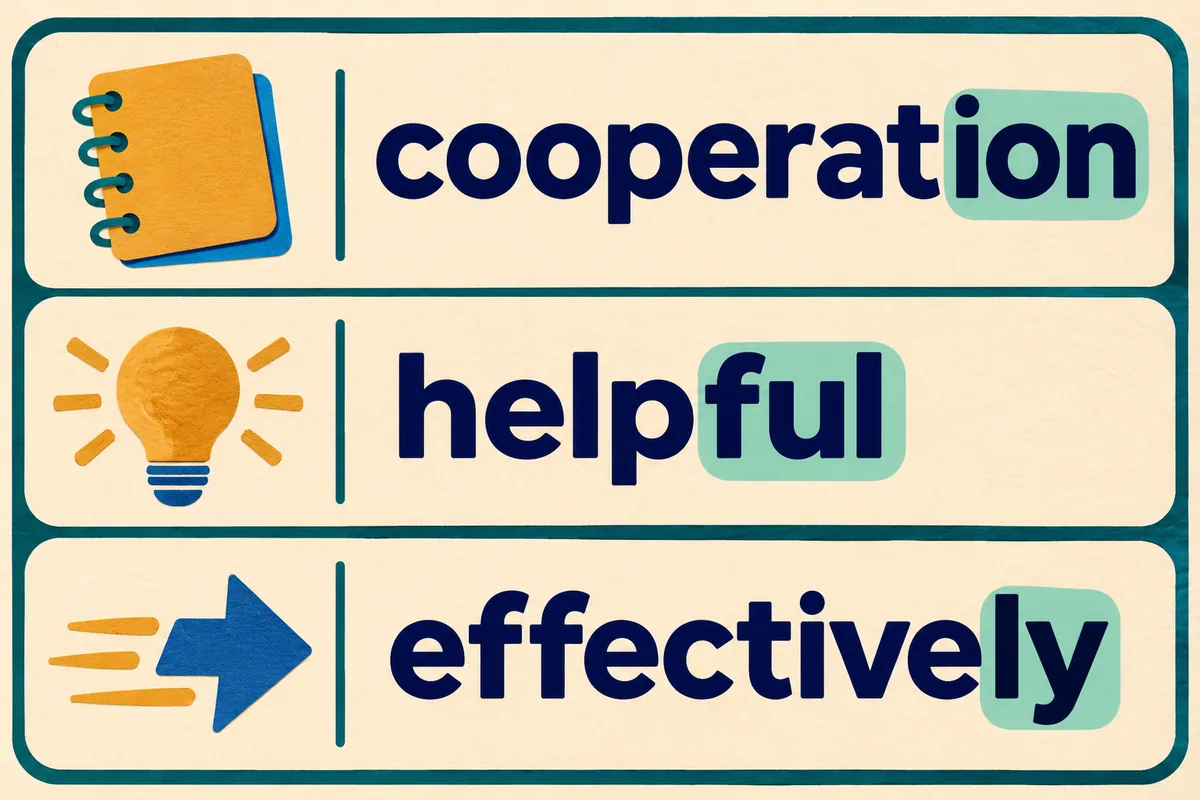
| noun | cooperation, development, kindness, organiser | after an article or adjective, or as a subject |
| adjective | helpful, harmless, creative, sustainable | before a noun or after a linking verb |
| verb | organise, strengthen, widen | after to or a modal in the appropriate construction |
| adverb | carefully, responsibly, effectively | to describe how an action is done |
Find the form before you add an affix
Step by step
Solve a word formation gap
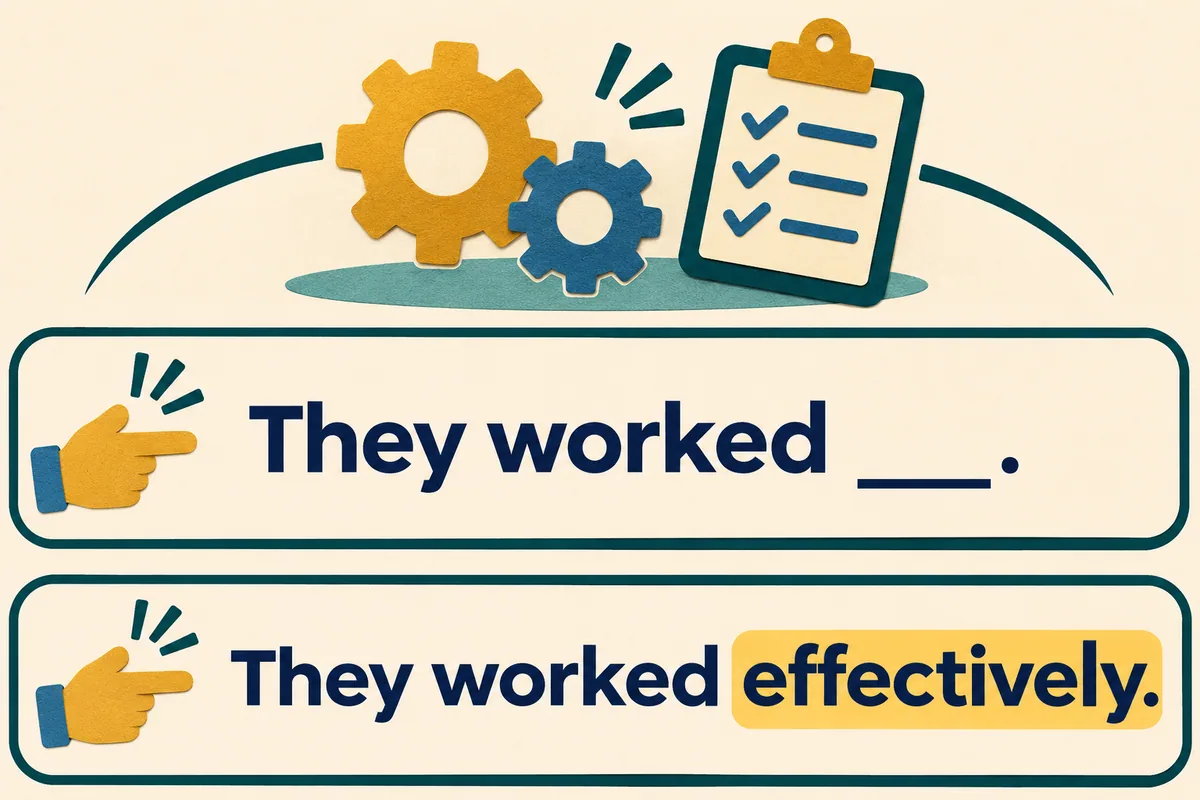
- In « The two groups worked ___ (effective) », the gap describes how they worked.
- Choose the adverb effectively and read the sentence back.
- Check spelling changes, as in happy → happiness and possible → possibility. Some forms use a different stem, as in decide → decision.
Remember
Negative prefixes are not interchangeable. Learn forms such as impossible, inactive and irresponsible as complete words.
Worked examples: building and choosing word forms
Building a word family
Build as many words as you can from help and say what each one means.
- Add -ful to make an adjective meaning giving help: helpful.
- Add -less to make an adjective meaning without help or unable to act: helpless.
- Add -er to name the person: a helper.
- Add un- to helpful for the opposite: unhelpful. Add -ly to helpful for the adverb: helpfully.
Choosing the negative prefix
Make the opposites of legal, regular, polite and happy.
- Il- usually goes before l: illegal.
- Ir- usually goes before r: irregular.
- Im- usually goes before p, m or b: impolite.
- Un- is the most common prefix: unhappy. Since these are tendencies rather than rules, check a dictionary and learn each opposite as a whole word.
Sources and curriculum
- English Language Guidelines for Secondary Schools (Ministry of Education, 2007)
The 2nd Baccalaureate syllabus describes the ten themes, four skills and language structures. See printed pages 76–84.
- National Baccalaureate Exam Specifications (English, 2025)
Reproduction of the national framework for the reading, language and writing sections, including the science streams.
Frequently asked questions
How do I choose the correct word form in a 2 Bac exercise?
What is the difference between a prefix and a suffix?
Exercises with answers
4 exercises, from easy practice to challenges. Try each one yourself, then reveal the answer and explanation.
Exercise 1
EasyWrite the opposite of each word with a prefix.
- legal
- possible
- honest
- understand
- agree
- patient
Answer and explanation
- Illegal.
- Impossible.
- Dishonest.
- Misunderstand.
- Disagree.
- Impatient.
Exercise 2
Intermediate- The two associations agreed to ___ (operation) on the project.
- A clear plan can make a project more ___ (effect).
- It is ___ (responsible) to publish personal information without permission.
Answer and explanation
- Cooperate. The gap needs a base verb meaning work together.
- Effective. The adjective describes the project.
- Irresponsible. The adjective after is needs a negative meaning.
Exercise 3
IntermediateComplete each sentence with the correct form of the word in brackets.
- The ___ (organise) of the event took two months.
- The long drought has ___ (weak) the trees.
- It was ___ (care) to leave the door open.
- We thanked them for their ___ (kind).
- The project supports the economic ___ (develop) of rural areas.
- Swimming here is ___ (danger) because of the currents.
Answer and explanation
- Organisation.
- Weakened.
- Careless.
- Kindness.
- Development.
- Dangerous.
Exercise 4
ChallengeComplete the text with the correct form of each word in brackets.
« UNICEF works (1) ___ to protect children. In many (2) ___ countries, it supports the (3) ___ of schools and helps to make vaccines (4) ___ to families who live far from hospitals. Much of its work depends on the (5) ___ of donors. »
- Gap 1 (tire)
- Gap 2 (develop)
- Gap 3 (improve)
- Gap 4 (avail)
- Gap 5 (generous)
Answer and explanation
- Tirelessly. The adverb describes how it works, with -less meaning without and -ly for the adverb.
- Developing. The adjective describes countries that are still developing.
- Improvement. After the, use a noun.
- Available. After makes vaccines, use an adjective.
- Generosity. After the, use a noun.