



Writing About Causes, Effects and Solutions
A causes, effects and solutions article explains why a problem happens, what follows, and who can do something about it. Support each main point with a concrete example and match each solution to the cause it addresses.
By the end of this lesson, you can
- Plan an article around the three parts of the prompt.
- Explain cause and effect and propose a realistic solution.
Un bon cours, ça se partage.
How do you plan a causes, effects and solutions article?
Step by step
Develop each paragraph
- Give the article a clear title and identify the problem.
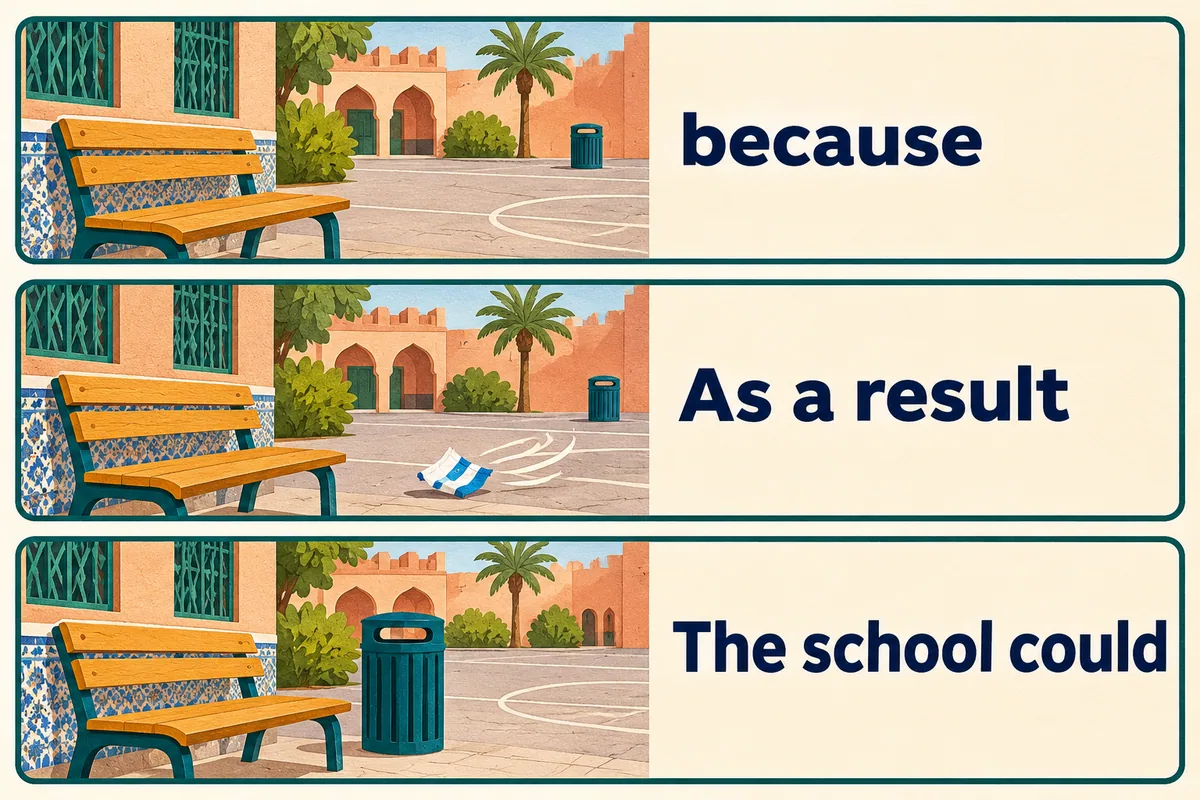
- Use because or due to to explain one or more causes.
- Use as a result or consequently to show a specific effect.
- Suggest action, name who can take it and say how it helps.
Model article · Keeping our schoolyard clean
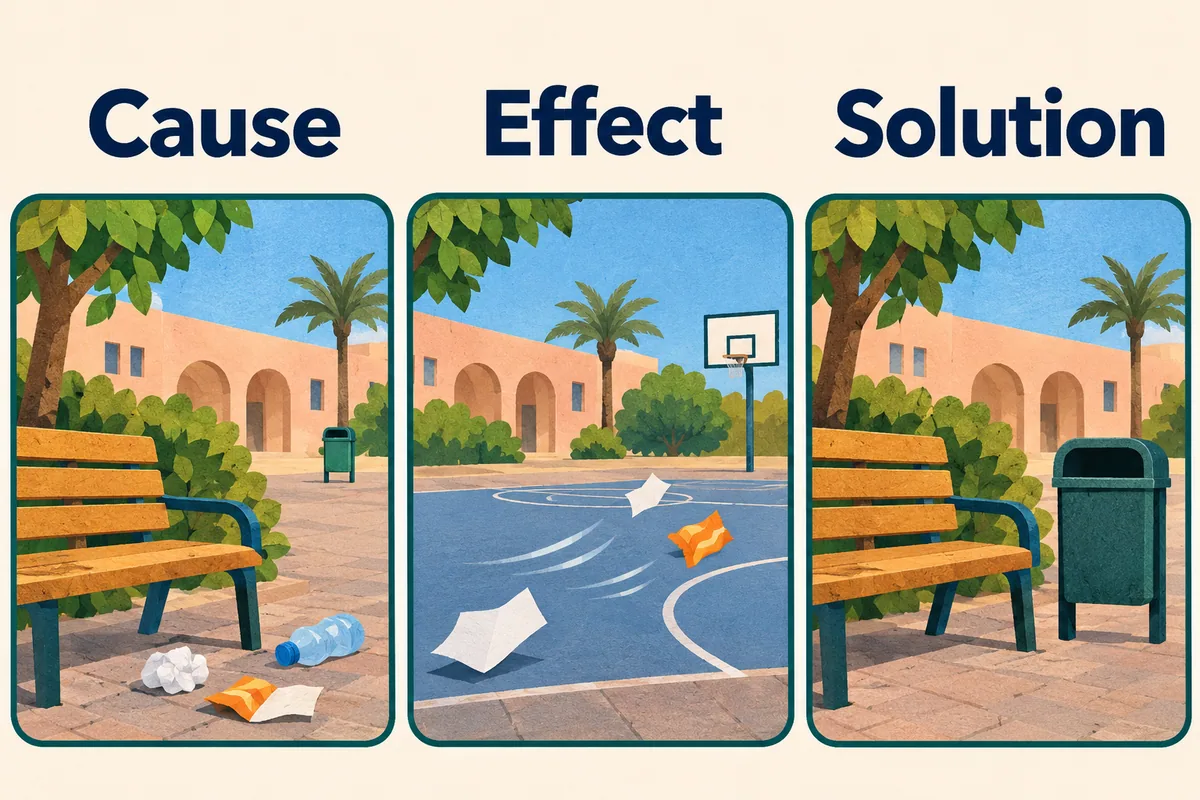
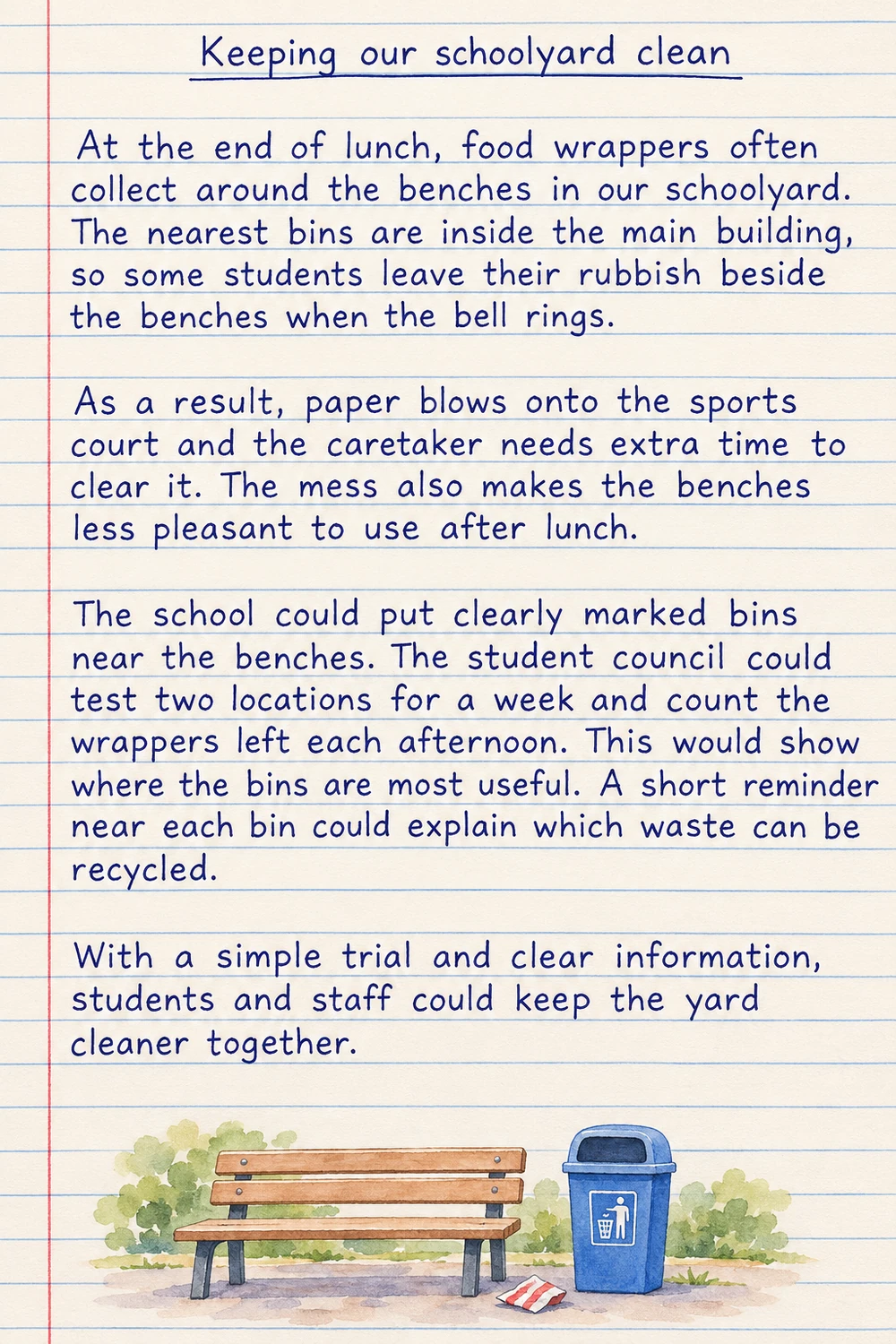
At the end of lunch, food wrappers often collect around the benches in our schoolyard. The nearest bins are inside the main building, so some students leave their rubbish beside the benches when the bell rings.
As a result, paper blows onto the sports court and the caretaker needs extra time to clear it. The mess also makes the benches less pleasant to use after lunch.
The school could put clearly marked bins near the benches. The student council could test two locations for a week and count the wrappers left each afternoon. This would show where the bins are most useful. A short reminder near each bin could explain which waste can be recycled.
With a simple trial and clear information, students and staff could keep the yard cleaner together.
Adapt the article to the task
An article for a school magazine can have a short title and a direct opening. If the task asks for a single paragraph, keep the same logical sequence within that paragraph. Start with a topic sentence and check that each sentence develops it.
Worked examples: matching solutions to causes
One solution for each cause
Problem: few young people vote in local elections. Causes: many do not know how to register, and many feel their vote does not matter.
- List each cause separately, then look for a solution that answers it directly.
- Cause 1 (registration) → Solution 1: « Schools could hold registration workshops for students who turn eighteen. »
- Cause 2 (the feeling that a vote does not matter) → Solution 2: « Local councillors could meet students to explain which decisions the council takes. »
- A solution that answers no cause, such as « Young people should be more serious », adds nothing to the article.
Varying cause and effect linkers
Rewrite « The beach is dirty because there are no bins. People stop going. » with more varied linkers.
- Start with the cause as a noun phrase: « Because of the lack of bins, rubbish piles up on the beach. »
- Show the effect with a verb: « This leads to fewer visitors in summer. »
- Add a second effect with as a result: « As a result, local cafés lose customers. »
Sources and curriculum
- English Language Guidelines for Secondary Schools (Ministry of Education, 2007)
The 2nd Baccalaureate syllabus describes the ten themes, four skills and language structures. See printed pages 76–84.
- National Baccalaureate Exam Specifications (English, 2025)
Reproduction of the national framework for the reading, language and writing sections, including the science streams.
Frequently asked questions
How do I write a causes, effects and solutions paragraph?
Which expressions can I use to suggest solutions in English?
Exercises with answers
4 exercises, from easy practice to challenges. Try each one yourself, then reveal the answer and explanation.
Exercise 1
EasyThe topic is litter on beaches. Classify each sentence.
- Many beaches have too few bins.
- Plastic waste harms sea turtles and fish.
- The town could install more bins near the cafés.
- Some visitors leave their rubbish behind.
- Fewer tourists visit dirty beaches.
- Schools could organise awareness campaigns before the summer.
Answer and explanation
- Cause.
- Effect.
- Solution.
- Cause.
- Effect.
- Solution.
Exercise 2
Intermediate- Write a short paragraph about why students miss the information on a crowded noticeboard and how the school could help.
Answer and explanation
- One answer is « Students often miss club announcements because the noticeboard is crowded with old posters. As a result, some clubs receive too few sign-ups. The student council could reserve a space for each week’s announcements and remove expired notices every Friday. »
Exercise 3
IntermediateComplete the paragraph with because of, as a result, one solution, this means and could.
« (1) ___ the long distance between home and school, many students in rural areas arrive late or tired. (2) ___, some of them miss the first lesson of the day. (3) ___ that they fall behind in important subjects. (4) ___ would be a school bus service. Local councils and associations (5) ___ share the cost. »
- Gap 1
- Gap 2
- Gap 3
- Gap 4
- Gap 5
Answer and explanation
- Because of.
- As a result.
- This means.
- One solution.
- Could.
Exercise 4
ChallengeWrite an article of about 130 words for your school magazine about why many students do not join school clubs. Explain the causes and effects and suggest solutions.
- Write your article.
Answer and explanation
- Possible answer: « Why are our clubs half empty? Our school has six clubs, but only a few students attend them. There are two main causes. First, most clubs meet after the last lesson, when many students have to catch the bus home. Second, new students often do not know that the clubs exist, because the information is only on one noticeboard. As a result, the clubs struggle to organise events, and students miss a chance to develop new skills and make friends. One solution would be to hold some meetings at lunchtime, so that bus users can take part. In addition, each club could present its activities to first-year classes in September. With these simple changes, our clubs could become the heart of school life. »