



Conditionals, Wish and If Only
Conditionals express a result that depends on a condition. Type 3 uses if + past perfect and would have + past participle to imagine a different past. Wish and if only use the past form for an unreal present and the past perfect for an unreal past.
By the end of this lesson, you can
- Choose the conditional pattern that fits the time and likelihood.
- Express unreal wishes about the present and regrets about the past.
Un bon cours, ça se partage.
Conditional types 0, 1, 2 and 3
| Type | Typical form | Example and meaning |
|---|---|---|
| Zero | if + present simple, present simple | If the signal is weak, the device disconnects. This describes a general behaviour. |
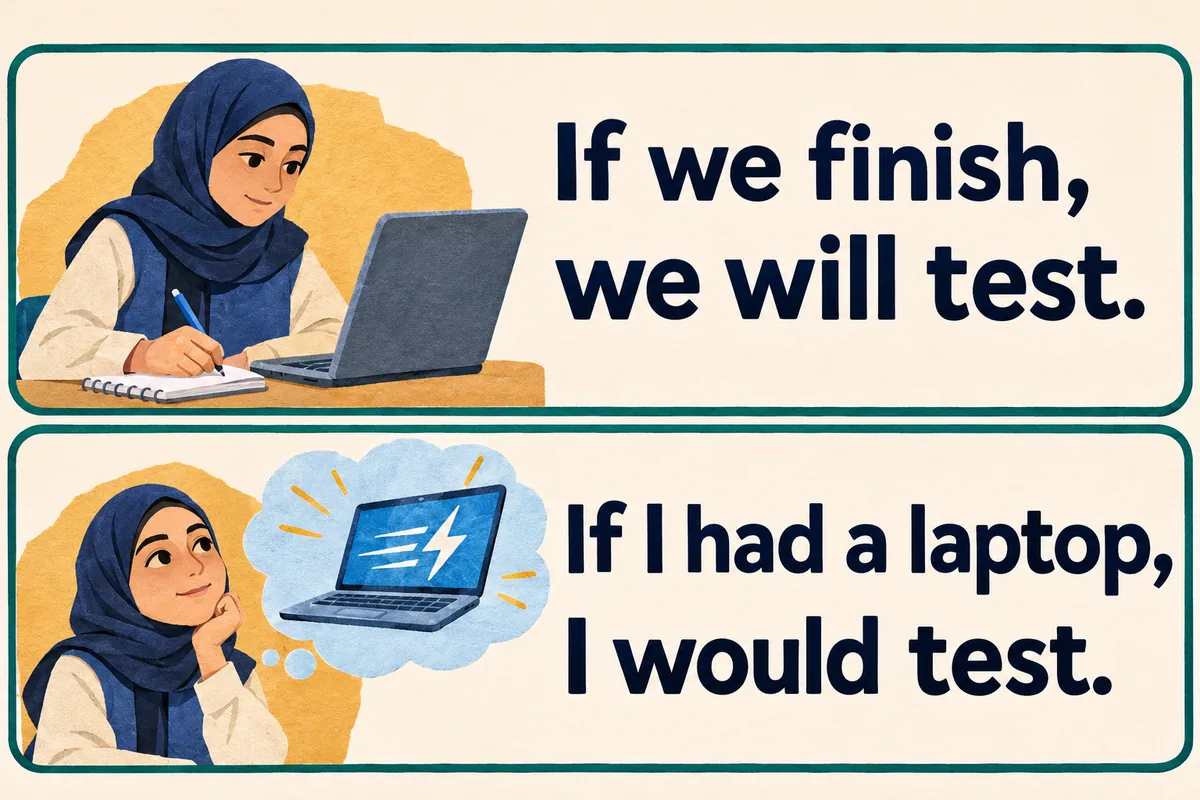
| First | if + present simple, will + base verb | If we finish today, we’ll test the app tomorrow. The completion is a real possibility. |
| Second | if + past form, would + base verb | If I had a faster laptop, I would run the simulation. The situation is imagined. |
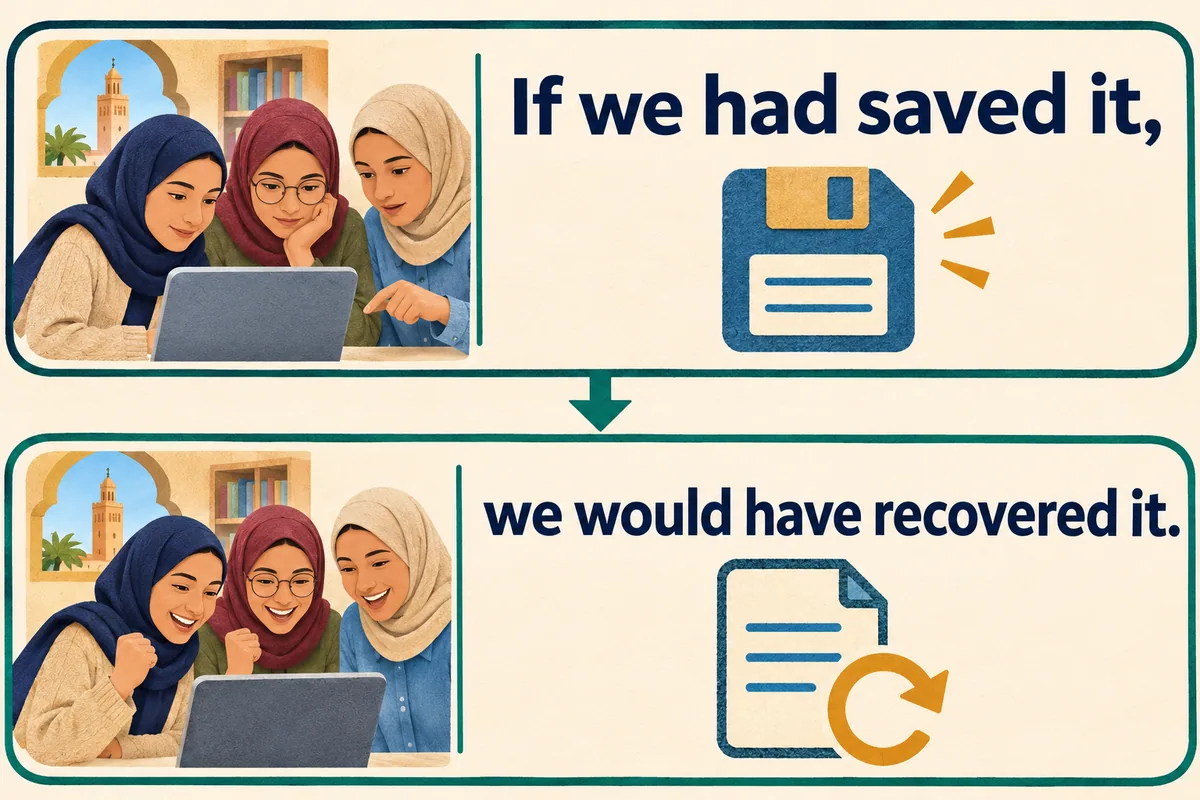
| Third | if + past perfect, would have + past participle | If we had backed up the file, we would have recovered it. Both events are imagined alternatives to the past. |
Could and might can replace would when a result concerns ability or possibility, as in « If we had brought a spare cable, we could have finished ». When the if-clause comes first, add a comma. In ordinary textbook patterns, put will or would in the result clause.
Wish and if only for the present and past
| Meaning | Pattern | Example |
|---|---|---|
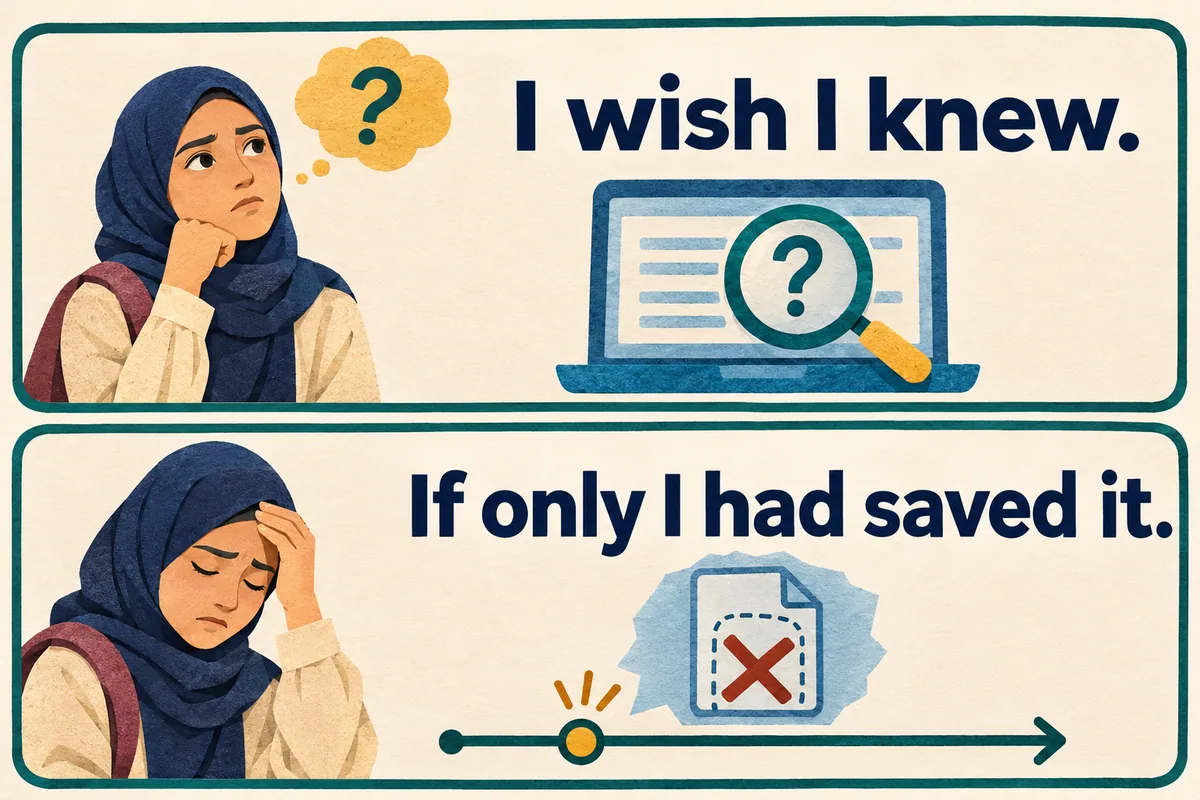
| unreal present | wish / if only + past form | I wish I knew how to fix the projector. |
| past regret | wish / if only + past perfect | If only I had saved a copy. |
| desired change in behaviour | wish + would + base verb | I wish people would stop leaving the printer on. |
Use the timeline in an exam rewrite
Start by identifying what actually happened. « We lost the file because we didn’t back it up » describes two past events. With if, write « If we had backed up the file, we wouldn’t have lost it ». With wish, focus on a single regret, as in « I wish we had backed up the file ».
Remember
In formal hypothetical patterns, were is common with all subjects, as in « If I were you » and « I wish she were here ».
Worked examples: choosing the conditional
From a real situation to an unreal condition
Rewrite « I don’t have a laptop, so I can’t practise coding at home » with if.
- The situation is real and in the present: I don’t have a laptop.
- To imagine the opposite in the present, use the second conditional: if + past form.
- Make both halves positive, because you imagine the opposite: « If I had a laptop, I could practise coding at home. »
A past condition with a present result
Rewrite « I didn’t study programming, so I’m not a developer now » with if.
- The condition is in the past (I didn’t study), so it takes the past perfect: « If I had studied programming ».
- The result is in the present (I’m not a developer now), so it takes would + base verb: « I would be a developer now. »
- This mixed conditional joins type 3 and type 2: « If I had studied programming, I would be a developer now. »
Sources and curriculum
- English Language Guidelines for Secondary Schools (Ministry of Education, 2007)
The 2nd Baccalaureate syllabus describes the ten themes, four skills and language structures. See printed pages 76–84.
- National Baccalaureate Exam Specifications (English, 2025)
Reproduction of the national framework for the reading, language and writing sections, including the science streams.
Frequently asked questions
How do I form conditional type 3?
What does unless mean in a conditional sentence?
Exercises with answers
4 exercises, from easy practice to challenges. Try each one yourself, then reveal the answer and explanation.
Exercise 1
EasySay whether each sentence is a zero, first, second or third conditional.
- If you heat ice, it melts.
- If it rains tomorrow, we’ll stay at home.
- If I were rich, I’d build a science lab in my village.
- If she had revised, she would have passed.
- Unless you charge it, the phone will die.
Answer and explanation
- Zero conditional: a general fact.
- First conditional: a real future possibility.
- Second conditional: an imagined present.
- Third conditional: an imagined past.
- First conditional. Unless means if not.
Exercise 2
Intermediate- We didn’t check the battery, so the device stopped. Begin with « If we … ».
- I can’t download the report now. Begin with « I wish … ».
- I forgot to send the application yesterday. Begin with « If only … ».
Answer and explanation
- If we had checked the battery, the device would not have stopped. Both events refer to the past.
- I wish I could download the report now. Could expresses an unreal present ability.
- If only I had remembered to send the application yesterday. Past perfect expresses the past regret.
Exercise 3
IntermediateComplete each sentence.
- If I ___ (have) more time, I would learn to code.
- If you ___ (press) this button, the machine starts.
- If we ___ (leave) now, we will catch the train.
- If he ___ (not / forget) his password, he could have logged in.
- I wish I ___ (can) speak Chinese.
- If only she ___ (listen) to my advice yesterday!
Answer and explanation
- Had.
- Press.
- Leave.
- Hadn’t forgotten.
- Could.
- Had listened.
Exercise 4
ChallengeRewrite each sentence with the word in brackets. Keep the meaning.
- I didn’t know about the scholarship, so I didn’t apply. (If)
- I live far from the university, and I regret it. (I wish)
- You must save your work or you’ll lose it. (Unless)
- My brother keeps borrowing my phone, and it annoys me. (I wish … would)
- It’s a pity I didn’t back up my files. (If only)
Answer and explanation
- If I had known about the scholarship, I would have applied.
- I wish I lived closer to the university.
- Unless you save your work, you’ll lose it.
- I wish my brother would stop borrowing my phone.
- If only I had backed up my files.